
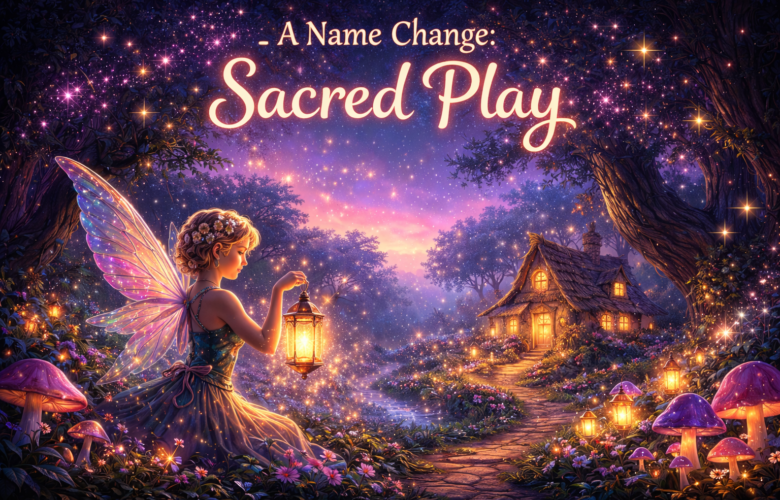
If you’ve been wandering these halls for a while, you might have noticed the sign out front has been… rearranged. Again. Like a raccoon with a label maker.
Yep.
The Church of Tinkerbell is now The Church of Sacred Play.
This post is the official “we didn’t move, we just changed what the door says” announcement. It’s also a small love letter to names, symbols, and the quietly rebellious idea that you can hold wonder and skepticism in the same hands without one stabbing the other with a tiny fork.
If you want the practical reasons, they’re here. If you want whimsy, gentle satire, and a little heartfelt “hey, the world is weird and we’re trying,” also here.
The short version
We changed the name because it fits what this place actually is:
- Wonder without worship
- Meaning without dogma
- Kindness without conditions
- Critical thinking without coldness
- Imagination as a mirror, not a mandate
And because “Sacred Play” is basically the project’s soul wearing a name tag.
Names are spells (even when you don’t believe in spells)
Not thunder-and-wands spells. Language spells.
A name is a tiny ritual we repeat every time we say it. It tells people how to enter. It suggests whether they should bring a hymn book, a sketchbook, or an emergency exit plan.
And over time, a project grows. It gathers layers. It learns new ways to breathe. Sometimes the old name still works, but it starts to steer the wrong expectations into the driveway.
So this isn’t a breakup. It’s a wardrobe shift. Same body. Different jacket. One that doesn’t itch.
Why “Tinkerbell” worked… and why it started to pinch
First: gratitude.
Tinkerbell was a great symbol for a while. It carried:
- whimsy
- playful rebellion
- a wink at overly-serious certainty
- the idea that belief animates worlds (which is both beautiful and, occasionally, a public health concern)
But symbols don’t only mean what we intend. They also mean what everyone else brings with them in the suitcase.
Over time, a few things became clear:
1) The shadow of someone else’s castle
“Tinkerbell” is widely associated with a specific corporate universe and a very specific cultural package delivered by a certain mouse. For many people, it immediately evokes one thing and one thing only.
Not bad. Just… narrowing.
This project is bigger than a single reference point. It’s satire sometimes, yes. But it’s also earnest. It’s about compassion, liberation from shame, clear thinking, and the stubborn refusal to outsource our ethics to fear.
We wanted the sign to point to this house, not to a neighboring theme park.
2) We didn’t want the message trapped inside the joke
Satire is a trickster tool. It slips truth past defenses.
But satire has a known side effect: some people hear the laugh and stop listening.
The name “The Church of Tinkerbell” often read as “only parody,” which meant some folks never found the deeper layers underneath: the tenderness, the science-minded reverence, the practical tools for thinking clearly when emotions are loud.
We didn’t want the title to act like a bouncer who only lets in people wearing irony.
3) The project has matured (without becoming boring)
This space started with playful sparks. It still has them. It always will.
But it has also become a kind of mythic workshop: part sanctuary, part comedy club, part classroom, part art studio, part “let’s unlearn the harmful stuff together without anyone getting shamed for being human.”
We needed a name that could hold the whole palette, not just the glitter.
So why “The Church of Sacred Play”?
Because those two words are the whole thesis, condensed into a single sign you can hang above the door without needing a footnote.
Let’s break them open.
Sacred: not supernatural, but significant
When we say sacred, we don’t mean:
- unquestionable
- authoritarian
- “please whisper, the carpet is holy”
- or “if you doubt, you’re bad”
Here, sacred means:
- worth tending
- worth protecting
- worth returning to when life gets sharp
It’s the kind of sacred you feel when you see someone choose kindness in a world that keeps offering them excuses not to.
It’s the kind of sacred that doesn’t ask you to lie to yourself.
Play: the serious medicine we keep pretending is dessert
Play is not the opposite of seriousness.
Play is the opposite of despair.
Play is how we:
- learn without panic
- explore without punishment
- practice empathy without a lecture
- revise beliefs without humiliation
- build resilience without pretending we’re robots
Play is where the mind says, “What if?”
And “What if?” is the first candle in every dark room.
So “Sacred Play” means: Wonder and growth, treated as real and valuable, without coercion.
It’s the only “church” I’m interested in: one that doesn’t demand certainty, but invites curiosity.
The deeper reason (the one that doesn’t sparkle, but shines)
This project exists because a lot of people were handed a false choice:
- Be rational and become cold
or - Be spiritual and abandon rigor
But the world needs more people who can do both:
- think carefully
- feel deeply
- admit uncertainty
- change their minds
- practice compassion without making it conditional
- resist dogma without becoming cynical
Sacred Play is my way of saying:
You don’t need supernatural claims to live with wonder.
You don’t need shame to be moral.
You don’t need fear to be good.
You don’t need certainty to be brave.
The humorous reason (because we are still us)
Also: “The Church of Sacred Play” is a wonderful name because it sounds like we might have incense and chanting…
…and then you walk in and discover a worksheet about cognitive biases, a story about a fairy who refuses to bully anyone, and someone gently reminding you to drink water.
Which feels honest.
Also also: “Sacred Play” has the benefit of sounding profound in a way that makes it harder for your inner critic to heckle you.
Inner critic: “This is silly.”
Sacred Play: “Yes. And?”
Inner critic: “…fine.”
What stays the same
This is important, so I’m putting it in clean, unglittered language:
- The heart of the project is the same.
- The mission is the same.
- The values are the same.
- The blend of satire, sincerity, imagination, and critical thinking is the same.
If anything, the new name simply makes more room for what was already here.
You’ll still find:
- compassion-centered ethics
- skepticism without sneering
- fantasy as a lens, not a literal claim
- tools for clearer thinking
- a soft landing for people recovering from shame-based belief systems
- and an undercurrent of “love is love” and “humans deserve dignity”
Same house. New sign. Slightly better lighting.
What this change signals going forward
Names don’t just describe. They invite.
And this name invites a few things I want more of here:
1) More wonder, less defensiveness
Wonder relaxes the nervous system. It makes people curious. It makes them less likely to cling to brittle certainty like it’s a flotation device.
This space is for growth without shaming.
2) More play as an actual tool (not a guilty pleasure)
Play is not “extra.” Play is how humans learn to be free.
We’re going to keep using storytelling, humor, metaphor, and imagination as a way to:
- surface assumptions
- soften fear
- practice empathy
- and rebuild meaning on purpose
3) More accessible entry points
If someone stumbles in here because “Sacred Play” sounds like a comforting thing they didn’t know they were allowed to want, perfect.
If they came for whimsy and stay for epistemology, also perfect.
A small ritual for the name change (optional, but delightful)
No mysticism required. Just symbolism, because the human brain loves symbols. The human brain is a meaning-making creature that keeps trying to make everything into a story, including receipts.
Try this:
- Think of one belief you once held tightly that you now see differently.
- Whisper: “Thank you for trying to protect me.”
- Whisper: “I release you now.”
- Imagine it turning into confetti and drifting into the night sky.
Not magic. Just practice.
Welcome to The Church of Sacred Play
If you’re new here: welcome. We’re glad you found us.
If you’ve been here awhile: thank you for walking with this project as it changes shape.
The name has changed, but the lantern light stayed the same:
A better world built from empathy, clarity, courage, and a stubborn refusal to let wonder die.
May your questions stay sharp,
your heart stay soft,
and your play stay sacred.

