
Or: Lines We Choose Not to Cross
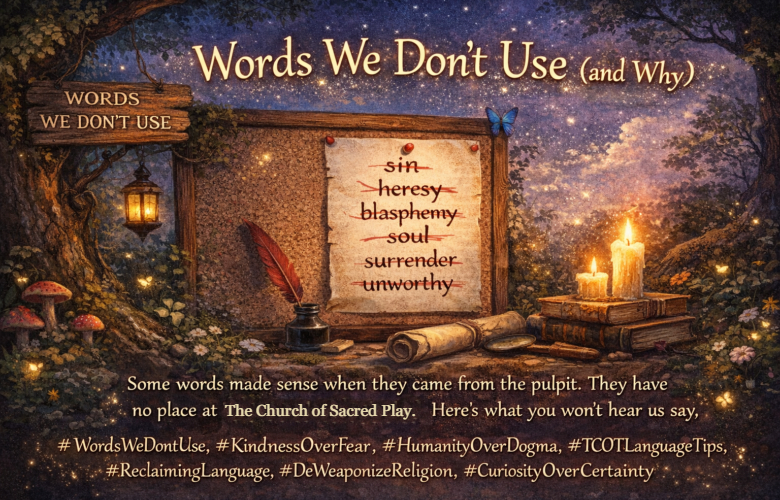
Just as important as the words we reclaim are the words we deliberately set aside.
At The Church of Sacred Play, language is a tool for clarity, care, and imagination—not control. Some words are so often used to shut down curiosity, excuse harm, or demand obedience that keeping them would work against everything we’re trying to build.
This page explains a few of the words we intentionally do not use—and why.
Divine (as Authority)
We do not describe ideas, rules, or values as divinely commanded or divinely authoritative.
Why?
- Appeals to divine authority end conversations instead of opening them
- They bypass evidence, consent, and accountability
- They turn disagreement into moral failure
If something is good, it should be defensible in human terms.
Sin
We don’t use sin as a category for human behavior.
Why?
- Sin frames harm as moral stain rather than understandable action
- It encourages shame over repair
- It often targets identity instead of behavior
We talk instead about:
- Harm and impact
- Responsibility and repair
- Growth, context, and learning
Evil (as Identity)
We avoid labeling people as evil.
Why?
- It flattens complex humans into caricatures
- It justifies cruelty and dehumanization
- It blocks understanding and change
We can name harmful actions clearly without declaring someone irredeemable.
Absolute Truth (Capital-T)
We don’t claim final, infallible, or absolute truth.
Why?
- Human knowledge is provisional and revisable
- Certainty ages poorly
- Progress depends on the ability to update our understanding
We value:
- Best available evidence
- Honest uncertainty
- Willingness to revise
Heresy
We don’t accuse people of heresy.
Why?
- The word exists to police thought
- It punishes curiosity
- It protects institutions, not truth
Disagreement here is not betrayal. It’s participation.
Obedience
We don’t frame ethics in terms of obedience.
Why?
- Obedience prioritizes authority over empathy
- It discourages moral reasoning
- It trains people to comply rather than care
We value agency, consent, and ethical reflection.
Submission
We avoid submission as a virtue.
Why?
- It has been used to justify abuse, especially toward women and children
- It confuses trust with power imbalance
- It erases consent
Mutuality is not submission.
Salvation
We don’t promise salvation.
Why?
- It implies a brokenness only we can fix
- It creates dependence
- It frames life as a test instead of an experience
We talk instead about support, healing, liberation, and growth—ongoing, imperfect, and human.
Blasphemy
We don’t treat questioning, satire, or criticism as blasphemy.
Why?
- No idea should be protected from examination
- Humor and critique are tools for truth
- Offense is not harm
Nothing here is sacred because it is fragile.
Chosen / Elect
We don’t describe any group as chosen, elect, or specially favored.
Why?
- These ideas create in-groups and out-groups
- They justify exclusion and entitlement
- They undermine shared humanity
Belonging here is not earned.
Why This Matters
Words shape worlds.
By choosing our language carefully, we:
- Reduce harm
- Increase clarity
- Leave room for curiosity
- Protect human dignity
If you notice a word we avoid—or one we should reconsider—that conversation is welcome.
A Closing Reminder
Language evolves. So do we.
Nothing on this list is beyond discussion.
The only thing we won’t defend is unquestionable certainty.
Welcome to the conversation.

