
A Sacred Play sermonette for a world that keeps trying to turn cruelty into “normal”
There’s a strange fantasy many of us carry around like a lucky charm in our pocket:
When the moment comes, I’ll do the right thing.
When the stakes are high.
When history gets loud.
When someone needs defending in a way that feels cinematic enough to justify the fear.
But morality is not a cape you find in a closet on the day the city catches fire. It’s closer to breath, posture, reflex. It’s what your body and mind default to when your heart is thumping and the room has decided that decency is optional.
That’s why the small moments matter so much.
Because the world doesn’t usually ask us to betray our values in one grand leap. It offers us a staircase. Each step is tiny. Each step comes with a reason. Each step says, This doesn’t really count.
And then one day you look down and realize you’ve been walking for a while.
A brief clarifier: what we mean by “morality”
When people say “morality,” they often mean rules. Sometimes those rules are printed in a holy book. Sometimes they’re shouted by a politician. Sometimes they’re whispered by a community that mistakes tradition for truth.
That version of morality is simple: right is whatever the authority declares.
We’re talking about something different. Not because rules are always bad, but because rules are often borrowed. And borrowed morality can be returned the moment it becomes inconvenient.
Here’s the kind of morality we’re aiming at, the kind we try to practice like a craft:
- Freedom matters. People have a right to their own minds, bodies, identities, and lives.
- Harm matters. If an action predictably increases suffering or strips dignity, it’s suspect even if it’s popular.
- Help matters. When someone is in needless pain and I can reduce it without causing bigger harm, I should show up.
- And revision matters. A moral framework isn’t holy because it’s old. It’s sacred because it’s honest, tested, and willing to learn.
That last one is important. If we can’t revise in the presence of better evidence or deeper empathy, we aren’t practicing morality. We’re practicing loyalty.
So when we say “moral choices,” we’re not talking about spiritual scorekeeping. We’re talking about how to keep our humanity intact when the cultural weather turns ugly.
The idea: practice now, while the stakes are “small”
There’s a reason firefighters drill. It’s not because they enjoy alarms.
They drill because in the moment, your thinking gets hijacked. Your hands forget things. Your brain takes shortcuts. Your attention narrows to a tunnel.
We like to imagine we’ll act from our ideals under pressure. But most of us act from our habits.
That’s the uncomfortable truth and also the hopeful one.
Because habits can be built.
And the moral habits that protect us in a crisis are usually trained in ordinary rooms: breakrooms, group chats, family dinners, checkout lines, comment sections, parking lots, and the private theater of our own thoughts.
When a culture drifts toward lawlessness, scapegoating, or the casual normalizing of bigotry, it often doesn’t begin with violence. It begins with permission.
Permission to sneer.
Permission to simplify.
Permission to dismiss.
Permission to say, “They’re not like us,” as if “us” is a sacred species.
And permission is contagious.
So the question becomes: What are we rehearsing?
Every time we let cruelty slide because it’s awkward to address, we rehearse silence.
Every time we repeat a rumor because it “sounds true,” we rehearse carelessness.
Every time we treat a person as an avatar for our anger instead of a human being, we rehearse dehumanization.
These things don’t just happen. We practice them.
Which means we can practice their opposites.
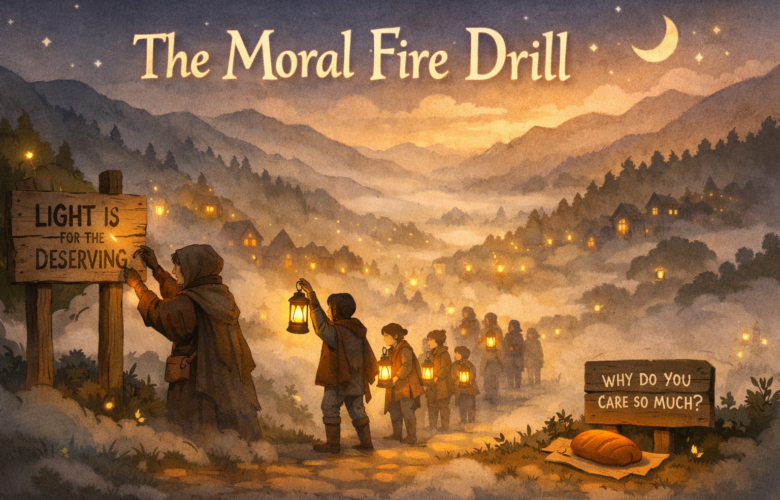
Sacred Play Vignette: The Lantern-Keepers of Gloamvale
In the valley of Gloamvale, fog was a regular visitor. Not the romantic kind you see in paintings, but the thick, hungry kind that swallowed roads and muffled voices until you couldn’t tell who was calling your name.
So the people of Gloamvale became lantern-keepers.
Every home had a lantern. Every pocket had a spark-stone. Every child learned the oldest valley rule:
“No one walks the fog alone.”
It wasn’t sentimental. It was practical. Fog made people disappear.
One year, a new voice arrived in the valley. It didn’t come on a horse. It came on a rumor.
The rumor said the fog wasn’t dangerous at all. The fog was just misunderstood. And besides, some people were “better suited” to the light than others.
At first, the rumor sounded harmless. Like background noise. Like a joke you could ignore.
But the rumor grew legs.
In the market, someone chuckled, “Why waste oil on strangers?”
At the tavern, someone said, “They should carry their own lanterns.”
At the schoolhouse, a parent muttered, “My kid shouldn’t have to walk with… those kids.”
One night, the fog rolled in thick as wool, and a bell rang from the lower road. A traveler had fallen. The sound was faint, like a last candle trying not to die.
Lantern-keepers stepped into the street.
Then a new rule appeared, posted on the meeting hall door in crisp ink:
LIGHT IS FOR THE DESERVING.
OIL IS LIMITED.
FOG IS NATURAL.
STOP MAKING A DRAMA OF IT.
People stood around reading it the way people always read cruel signs: with silence that pretends to be neutrality.
Then Old Mera, the baker with flour always dusting her sleeves, walked up and scraped the sign down with a butter knife.
No speech. No fury. Just a simple, ordinary motion.
She turned to the people and said, “We don’t do that here.”
Someone laughed nervously. “It’s just a sign.”
Old Mera nodded. “Yes. And if you let a sign practice you, it will.”
She lifted her lantern. The light made a small warm circle on the cobblestones.
A teenager named Wren stepped forward, hands shaking a little, and said, “I’ll go.”
Then another. Then another. Soon a line of lanterns moved into the fog like a slow constellation.
They didn’t argue with the fog. They didn’t insult the people who believed the rumor. They didn’t pretend bravery was easy.
They just did the thing they had practiced when it was inconvenient rather than heroic.
At the lower road they found the traveler, knee bleeding, breath rattling, eyes wide with fear.
Wren knelt down and said, “You’re not alone.”
And for a moment, the fog seemed less like a monster and more like weather. Still real. Still dangerous. But not in charge.
When the group returned, someone had posted another sign, smaller this time, like a timid attempt:
WHY DO YOU CARE SO MUCH?
Old Mera smiled and answered it with a fresh loaf left on the steps.
On the paper wrapper, she’d written:
BECAUSE PRACTICE BECOMES PEOPLE.
Reflection: the signs we don’t notice anymore
In our world, the fog isn’t always literal. Sometimes it’s confusion. Sometimes it’s fear. Sometimes it’s propaganda that tells you compassion is weakness and cruelty is “strength.”
And sometimes the most dangerous thing isn’t the loud cruelty, but the soft normalization: the shrugging, the “it’s complicated,” the “both sides,” the weary acceptance that the worst parts of us should be treated as inevitable.
A culture can teach you to become someone you wouldn’t recognize in the mirror. Not quickly. Patiently. Like drip water carving stone.
So yes, it matters to practice moral choices now, while the stakes feel smaller, because “smaller” is often just what we call the early chapters.
You don’t wake up one morning and decide to be indifferent to suffering.
You wake up one morning and realize you’ve been rehearsing indifference for a while.
But here’s the bright sabotage of Sacred Play:
You can rehearse decency too.
The Moral Gym: a low-stakes rehearsal plan
Pick three practices for the next seven days. Don’t aim for perfection. Aim for repetition.
1) The One-Sentence Boundary
Choose a sentence you can say without needing a speech.
- “I’m not comfortable with that.”
- “I don’t find that funny.”
- “I don’t want to talk about people that way.”
- “I’m going to push back on that.”
Rehearse it out loud once a day, even alone. Yes, it feels silly. That’s the point. You’re teaching your mouth a new reflex.
2) The Gentle Interruption
When harm shows up dressed as “just talking,” interrupt it without turning it into a coliseum.
- “I think that’s based on a stereotype.”
- “What’s the evidence for that?”
- “Let’s be careful. That claim hurts real people.”
You don’t need to win. You need to break the spell of consensus.
3) Information Hygiene
Make truth a moral habit.
- Don’t share outrage bait without checking.
- If you’re not sure, don’t amplify.
- Correct something once, cleanly, then stop feeding the fire.
In a foggy world, truth is a lantern.
4) Micro-Help (the anti-cynicism vitamin)
Do one small act of help that costs you something real but sustainable: time, attention, money, energy.
- Reach out to someone who’s being targeted or isolated.
- Tip extra when you see someone being mistreated.
- Donate to a mutual aid fund.
- Offer a ride, a meal, a listening ear.
This is not about saviorhood. It’s about refusing to become numb.
5) Repair Practice
This one is sacred because it’s hard.
- “I stayed quiet earlier. I wish I hadn’t.”
- “I’m sorry. I want to do better.”
- “I didn’t handle that well. Can we try again?”
Repair turns morality from a self-image into a relationship.
6) Courage With Exit Ramps
Not every situation is safe. Morality is not self-destruction.
Practice alternatives:
- Leaving and supporting later
- Documenting
- Calling in allies
- Checking on the harmed person afterward
- Quietly providing resources
Courage has many costumes.
Journal prompts for the brave and the honest
Choose one:
- Where do I go silent to stay comfortable?
- What kind of cruelty do I excuse because it’s familiar?
- What is one sentence I want in my mouth before I need it?
- What’s a belief I’ve inherited that I’m willing to revisit?
- If my morality is about freedom and minimal harm, what does that ask of me this week?
Write for ten minutes. No polishing. No performance. Just truth.
Closing blessing (non-magical, still sacred)
May you become the kind of person you trust.
May your values learn to walk on two feet.
May your compassion stay practical.
May your courage stay human.
May you practice the light, not because you’re certain you’ll be thanked, but because you refuse to let the fog have the final word.
Teaser for the next Sacred Play entry
Next time: “Lantern Words”
How to confront harm without becoming harm, with scripts, tone options, and a little map for when your nervous system wants to either fight, freeze, or disappear into the wallpaper.

