
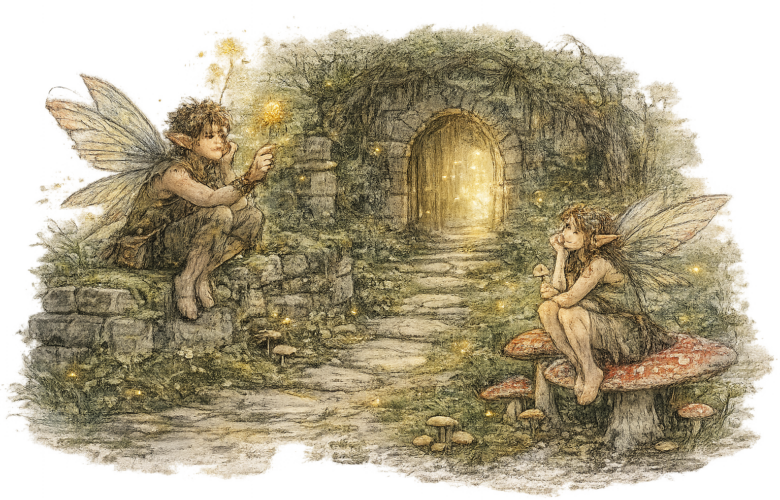
Spark-Editors of Attention, Keepers of the Small Holy “Oh”
Wonderverse Charter (read aloud if you like):
- The Wonderverse tells the truth in a form you can hold.
- Nothing is forced, and nothing is wasted.
- Wonder is not denial. Wonder is courage with good lighting.
Where they live
Fae do not “live” in forests, though forests make excellent costumes for them. They live in the moment right before you decide something is ordinary.
They nest in the hinge-place between glance and seeing.
Between background and beloved.
Between “I already know this” and “Wait, what is this, actually?”
In the Wonderverse, that hinge-place is a whole province, and the fae have built their cities there from stolen seconds and salvaged shimmer.
What they are
If you had to translate them into plain human terms, you could call them:
- the mind’s aesthetic immune system (they flare when numbness spreads)
- the psyche’s curiosity reflex (they twitch when wonder is threatened)
- the anti-dogma guild (they distrust conclusions that refuse to breathe)
But in the Wonderverse, translation is a secondary language. First language is lived experience. First language is a sudden laugh while you’re washing a plate, because the water made a tiny rainbow and for one second you remembered you are alive.
That’s a fae footprint.
What they do
Fae are not here to make your life “nice.” They’re here to make it real.
They take the full cosmic spectrum, blazing heat and unimaginable cold, the terrible and the tender, and they adjust your approach angle. Not by shrinking the truth. By making it edible.
They do this through three crafts:
1) Re-enchantment
Not “magic denial,” but attention returned to its rightful owner.
They make you notice:
- the specific sound of your kettle
- the ridiculous heroism of your houseplant
- the way your friend’s face changes when they’re trying to be brave
- the fact that grief is also love, refusing to evaporate
Re-enchantment is their way of saying: Don’t sleepwalk through the only life you get.
2) Defamiliarization
They take what you think you know and tilt it until you meet it again.
A fae may place one pebble of doubt into a surety you’ve been polishing for years, and suddenly the whole belief has to learn how to move like a living thing instead of a statue.
They are kind about this… unless you get arrogant.
Then they become educational.
3) Threshold-keeping
Fae are guardians of “the gate.” The gate is consent.
They do not break down the door to your mind and redecorate. They do not shove you into the deep end of the ocean to “build character.” They offer an open door and a candle and say, “If you want.”
In the Wonderverse, that phrase is sacred.
How they communicate
Fae speak in a dialect called Glint.
Glint is made of:
- coincidences that feel like winks
- small beauties that interrupt spirals
- playful obstacles that force you to slow down
- sudden clarity that arrives dressed as humor
They also speak through:
- songs that write themselves when you stop forcing them
- metaphors that land too perfectly to ignore
- gentle errors (you walk into the wrong room and remember what you needed)
Sometimes they speak through other creatures, the way wind speaks through leaves.
What they want
Fae do not want worship. They don’t even want agreement.
They want aliveness.
Their favorite offerings are almost insultingly simple:
- five minutes outside
- a glass of water drank like a ritual
- one honest sentence
- one small act of care
- laughter that doesn’t punch down
- curiosity that doesn’t demand to own
They adore sincerity. They hate performance.
If you try to impress them, they will watch politely until you get tired.
If you try to control them, they will teach you the difference between a plan and a prison.
Their taboos
The fae have two.
1) Dead Certainty
When a conclusion stops updating, it begins to rot.
Fae can smell rot.
They aren’t against confidence. They’re against the kind that refuses new evidence, refuses other minds, refuses reality’s complexity.
When dead certainty enters a room, the fae do what any sensible creature does when smoke rolls under the door.
They start opening windows.
2) Shame as a Governing System
Shame is heavy. Shame makes the body hide. Shame turns curiosity into threat.
Fae are built for wonder. Shame is an anti-wonder machine.
They will still come near you when you’re ashamed, because they aren’t cruel. But they’ll approach like you approach a wounded animal: softly, from the side, without sudden movements.
Signs you’ve encountered them
You may have been visited by fae if:
- you suddenly feel tender toward something you usually ignore
- you catch yourself being kinder than your reflex
- you notice beauty and it doesn’t feel like a distraction, it feels like fuel
- you feel the urge to explore a question, not to win it
- the world seems bigger, but you feel steadier inside it
A stronger sign:
You experience longing, not for escape, but for more contact with reality, because reality just proved it can be delicious.
The Fae Hazard List (gentle satire, for safety)
Fae are not dangerous in the “they eat you” sense. They are dangerous in the “they reintroduce you to yourself” sense.
Possible side effects include:
- accidental joy
- reduced tolerance for boring cruelty
- impulsive art-making
- noticing your own patterns
- saying “no” more clearly
- saying “yes” more honestly
Consult a professional if wonder persists longer than four hours.
Or don’t. The professionals are sometimes the problem. (The fae giggle here.)
A small ritual: The Five Glints
Do this once, or daily for a week.
- Glint of Senses: Name one thing you can hear that you usually ignore.
- Glint of Beauty: Find one small beautiful thing and look at it for ten slow breaths.
- Glint of Truth: Say one honest sentence, aloud, privately.
- Glint of Kindness: Do one tiny kind act with no audience.
- Glint of Wonder: Ask one question you don’t intend to answer today.
Close by saying: “Gate open, gently.”
A vignette from the Wonderverse
In the town of Hinge, where every street is a decision you haven’t made yet, a traveler once asked a fae for directions.
The fae held up a lantern and said,
“Where do you want to go?”
The traveler said, “Somewhere safe.”
The fae nodded, serious as stone.
Then the lantern brightened, and inside the glass you could see a tiny storm, a tiny sunrise, a tiny ocean, all at once.
“Safe,” said the fae, “is not a place. It’s a pace.”
And the traveler, who had been running for years, sat down for the first time without calling it failure.
The fae didn’t clap. They didn’t congratulate. They just warmed the air a little, the way a candle warms a room without making a speech about it.
Table of Contents
- Preface: How to Read a World That Isn’t “Real”
- Chapter 1: The Fae Folk
- Chapter 2: The Brownies and Domovoi
- Chapter 3: The Muses
- Chapter 4: The Djinn
- Chapter 5: The Selkies and Kelpies
- Chapter 6: The Golems
- Chapter 7: The Cauldron Spirits
- Chapter 8: The Oracles and Sibyls
- Chapter 9: The Trickster Kin
- Chapter 10: The Psychopomps
- Chapter 11: The Dryads and Greenwights
- Epilogue: The Taste of Returning

