
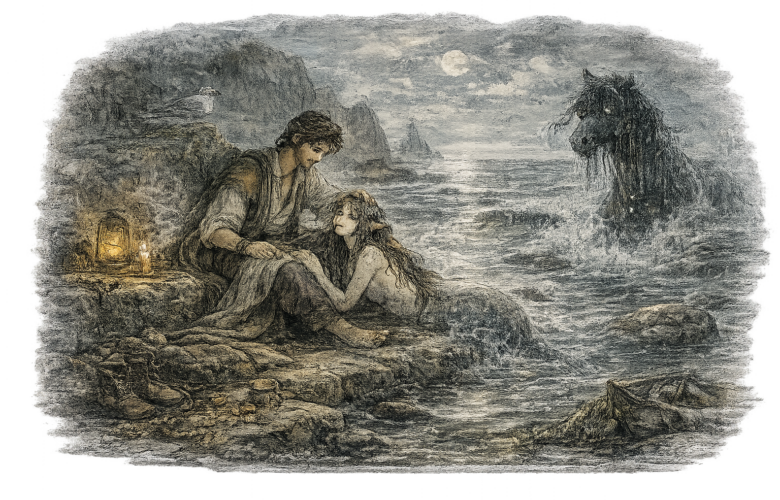
Shape of Longing, Keepers of the Shoreline of Becoming
Wonderverse Charter (read aloud if you like):
- The Wonderverse tells the truth in a form you can hold.
- Nothing is forced, and nothing is wasted.
- Wonder is not denial. Wonder is courage with good lighting.
Where they live
Selkies and kelpies live where identity meets water.
Not only literal water, though the Wonderverse enjoys giving metaphors good shoes. They live at the border where you stop being one self and begin to become another. They live in the tide line between:
- who you’ve been
- who you were expected to be
- who you are
- who you might be if you let yourself
In the Wonderverse, their domain is called The Shoreline of Becoming, a long, restless coast where the ocean speaks in languages you can’t quite translate until you stop trying to translate and start listening.
The sand there is made of shed roles. The foam tastes like old names dissolving.
What they are
In plain terms, selkies and kelpies are:
- the psyche’s shape-shifting instinct
- the mind’s belonging hunger wearing a sea-cloak
- the part of you that knows when you’re living inside a costume
- the truth that you can be more than one thing, and still be real
Selkies are often gentle. They carry tenderness like a seal carries sleekness, natural and unforced.
Kelpies are not “evil.” They are intensity. They are the river’s dare. They are desire mixed with momentum. They appear when you’re tempted to become something fast, because stillness feels unbearable.
Both are teachers of form.
Both ask the same question, in different tones:
“Is this shape chosen, or is it borrowed out of fear?”
What they do
They practice a craft called Tidework, which has three branches.
1) Unseal
Selkies are famous for their skins. In the Wonderverse, “skin” means any layer you wear so long you forget it’s removable.
They help you notice what you’ve been wearing:
- the agreeable version of you
- the invulnerable version
- the “I’m fine” version
- the version built to survive a room you no longer live in
Unsealing is not stripping. It’s remembering you have options.
2) Test the Water
They invite gentle experiments with identity.
Not dramatic reinventions unless you want them. Sometimes it’s as small as:
- speaking one truth you usually swallow
- wearing something that feels like you, not like your role
- letting a preference exist without defending it
- trying a new name for your own experience, privately
Selkies love small, safe experiments. They are deeply respectful of pacing.
Kelpies also test the water, but theirs is more… kinetic. They show you where momentum is dragging you. They reveal when you’re about to leap just to stop feeling stuck.
3) Return
Selkies are returners.
They bring you back to yourself after you’ve been shaped by other people’s expectations. They remind you that belonging is not something you purchase by becoming acceptable.
Return is their gentlest magic: the slow homecoming.
Kelpies also return you, though sometimes by showing you what happens when you don’t.
They are honest like that.
How they communicate
They speak in a dialect called Tide.
Tide sounds like:
- a sudden homesickness for something you can’t name
- relief when you stop performing
- longing that comes with a clear image (water, shore, moon, seal eyes)
- the sense that a life you’re living doesn’t fit your body
Selkies communicate through softness:
- dreams of swimming
- the urge to be quiet near people who feel safe
- tears that arrive without explanation, then leave you cleaner
Kelpies communicate through pull:
- obsession
- restlessness
- “If I don’t change everything right now I’ll die” energy
- desire that feels like a river current
Both are speaking.
Neither is automatically right.
The art is learning which one is yours, and which one is fear in a costume.
What they want
Selkies want belonging without captivity.
Kelpies want movement with consent.
Their favorite offerings:
- honesty that doesn’t punish you
- boundaries that aren’t apologies
- one choice made for the sake of your real self, not the self you’re trying to sell
- time near water (literal or metaphorical) where you let yourself feel without solving
They love when you say:
“I can change shape without losing my soul.”
That sentence is a shoreline lantern.
Their taboos
They have two.
1) Belonging as a Cage
Sometimes “home” becomes a trap because you confuse familiarity with safety.
A cage can be made of:
- a relationship where you shrink
- a role that praises you for disappearing
- a community that loves you only when you’re quiet
- a version of yourself you built to be survivable
Selkies mourn cages. Kelpies kick them.
Either way, the cage does not remain unchallenged.
2) Self-Betrayal Sold as Virtue
Some cultures worship self-erasure and call it goodness.
Selkies and kelpies do not.
They understand sacrifice. They even respect it, when chosen freely and wisely. But they have no patience for the holy performance of abandoning yourself.
If you keep calling self-betrayal “maturity,” the kelpies start showing up more often, snorting steam at the edge of your mind.
Signs you’ve encountered them
You may have been visited if:
- you feel relief when you admit a preference you’ve been hiding
- you realize you’ve been living as a version of you designed for someone else
- you feel drawn to a change that is quiet, not dramatic
- you notice longing and can sit with it without rushing to fix it
A stronger sign:
You begin to experience identity not as a courtroom, but as an ecosystem.
The Shoreline Hazard List (gentle satire, for safety)
Possible side effects of selkie/kelpie contact include:
- changing your mind and not treating it like a scandal
- unfollowing people who make you feel small
- sudden intolerance for “that’s just how you are” narratives
- experimenting with small freedoms that feel suspiciously healing
- becoming allergic to rooms where you have to pretend
If symptoms persist, avoid attempting to “be normal.”
Normal is often just a costume everyone agreed not to name.
Selkies roll their eyes at normal.
Kelpies bite it.
A small ritual: The Shoreline Check-In
Use this when you don’t know whether a change is true or frantic.
- Name the shape you’re in right now. (Role? Mask? Mood? Version of you?)
- Ask: “Does this shape let me breathe?” (Answer without debate.)
- Name the pull. What are you longing for beneath the story?
- Choose one small experiment that honors your breath without burning your life down.
- Choose one boundary that protects the experiment.
Close with the sentence:
“I will not confuse longing with urgency.”
A vignette from the Wonderverse
On the Shoreline of Becoming, the moon does not merely shine. It listens.
A traveler arrived at dusk carrying a coat that didn’t fit. It was a fine coat, praised by many. It had medals sewn into the lining, little proofs of being acceptable.
The traveler sat on a rock and stared at the sea as if waiting for it to apologize.
A selkie surfaced a few feet away, sleek and quiet, eyes dark as polished stones. It rested its chin on the water and watched the traveler without speaking.
The traveler spoke first, because silence is hard when you’ve been trained to earn love.
“I don’t know who I am anymore,” the traveler said, as if stating a weather report.
The selkie blinked slowly.
The traveler laughed, a brittle sound. “That’s helpful.”
The selkie slipped beneath the surface and reappeared closer, then set something on the wet sand.
A skin.
Not gore, not horror. A seal-skin folded like a garment, glistening in the moonlight, as ordinary as a towel after a swim.
The traveler stared. “Is that… yours?”
The selkie nodded.
“Why would you leave it there?”
The selkie’s voice, when it finally came, was like water over pebbles. “So you remember,” it said, “that a skin is something you can take off.”
The traveler’s throat tightened. “But what if I take it off and nobody likes what’s underneath?”
The selkie’s gaze did not flinch. “Then they liked the skin,” it said, with a gentleness that cut clean.
From farther down the shore, there came a sound like hooves striking wet stone.
A kelpie stood at the waterline, black as midnight, mane dripping, eyes bright with dangerous invitation. It pawed the surf as if impatient with conversation.
The traveler turned, startled, as the kelpie took a step forward.
“Come,” the kelpie said, not with words but with gravity.
The traveler’s heart surged. The urge to leap onto its back was sudden and wild, like the desire to burn down everything and call it rebirth.
The selkie watched the traveler’s face change.
“That one is loud,” the traveler whispered, embarrassed.
The selkie nodded. “It is not wrong,” it said. “But it is strong. Ask what it wants.”
The traveler faced the kelpie, pulse thundering. “What do you want?”
The kelpie snorted, and the surf hissed. In the sound was an answer, clear as a knife:
I want you to stop living as a guest in your own life.
The traveler swayed, tears rising. “I can’t just… leave everything.”
The selkie’s voice returned, steady as the horizon. “Then don’t,” it said. “But do not stay by disappearing.”
The traveler looked at the coat, heavy with other people’s praise.
Slowly, as if unlearning a spell, the traveler unbuttoned it and set it on the rock beside them.
Nothing catastrophic happened.
The moon did not judge. The ocean did not laugh.
The traveler’s shoulders dropped, and with that small release, the kelpie’s intensity softened. It stepped back into the surf, still there, still powerful, but no longer demanding a fire.
The selkie nudged the folded skin toward the traveler.
The traveler did not put it on. Not yet.
Instead, they placed a hand on it, feeling the slick truth of it: that identity is not a cage, and belonging is not purchased with self-erasure.
The traveler stood, barefoot now, toes in the cold foam, and said out loud, softly:
“I want to come home.”
The selkie smiled, barely. The kelpie lowered its head, a bow that was almost respect.
And the shoreline, which had always been a border, became a beginning.
Table of Contents
- Preface: How to Read a World That Isn’t “Real”
- Chapter 1: The Fae Folk
- Chapter 2: The Brownies and Domovoi
- Chapter 3: The Muses
- Chapter 4: The Djinn
- Chapter 5: The Selkies and Kelpies
- Chapter 6: The Golems
- Chapter 7: The Cauldron Spirits
- Chapter 8: The Oracles and Sibyls
- Chapter 9: The Trickster Kin
- Chapter 10: The Psychopomps
- Chapter 11: The Dryads and Greenwights
- Epilogue: The Taste of Returning

