
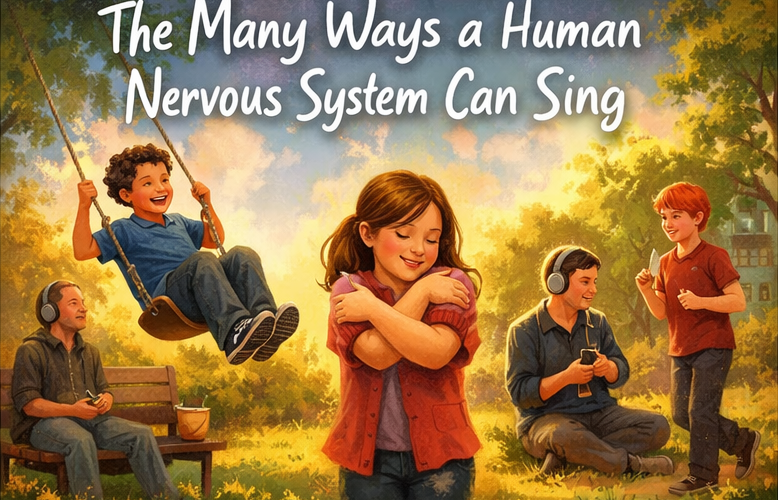


On some afternoons, Maya wraps her arms around herself and squeezes until the world grows quieter inside her body.
Eli wants the swing, always the swing. Something in that steady arc, forward and back, seems to help his whole system settle into itself. Nora jumps on the trampoline until her laughter and her heartbeat find the same rhythm. Sam repeats a phrase from a favorite show, not because he has nothing to say, but because those words arrived already carrying comfort, familiarity, and a path toward connection.
From the outside, if you do not understand what you are seeing, these things can look strange. But from the inside, they often make perfect sense. And that is part of what autism appreciation asks of us. It asks us to come closer. To look again. To trade shallow awareness for actual understanding. To move beyond merely recognizing that autistic people exist and toward honoring the rich, embodied, fully human ways autistic people move through the world.
At The Church of Sacred Play, we believe there is no single correct way to be a person. There is no one true rhythm of speech, movement, feeling, or regulation that all healthy lives must imitate. Human beings come into the world with different nervous systems, different thresholds, different delights, and different ways of finding balance. Those differences are not flaws in the fabric; rather, they are beautiful parts of the intricate tapestry of life.
Autism appreciation begins when we stop asking autistic people to disappear into someone else’s idea of normal, and we start learning how to recognize the wisdom found in the ways they already know how to live.
There Are More Senses Than Most People Were Taught
Many of us grew up hearing about the five senses: sight, hearing, smell, taste, and touch. Useful as a starting point, perhaps, but far too small for the actual orchestra of human experience.
Our bodies do much more than see and hear. They also track movement, balance, inner signals, pressure, and position. These sensory systems are part of everyday life for everyone, but for many autistic people, they are especially important for shaping comfort, distress, joy, communication, and self-regulation.
For example, there is proprioception, the sense that helps us know where our body is in space. It helps us feel position, pressure, force, and movement. It is part of why some people feel calmer when they are wrapped tightly in a blanket, pressed firmly in a hug, leaning into cushions, carrying something heavy, or squeezing themselves.
There is the vestibular system, which helps us experience balance and motion. It is part of why swinging, rocking, spinning, pacing, bouncing, or jumping may feel soothing, organizing, energizing, or joyful.
There is interoception, which helps us notice what is happening inside the body, such as hunger, thirst, temperature, nausea, fatigue, or the rising signs of overwhelm. These are not minor details. Rather, they are woven into how a person lives in their body. And for many autistic people, these senses are not background noise; instead, they are central characters.
Sensory Seeking Is Not Random
When people talk about autism and sensory experience, they often focus only on discomfort. They imagine loud rooms, painful textures, overwhelming lights, or too many competing sounds at once. Those are examples of sensory avoidance. It is real, and it matters. But it is only half the story.
Many autistic people are also sensory seeking. Lena loves deep pressure because it helps her breathe more fully. Jonah presses himself into the couch after school because it feels like his body can finally land somewhere. Priya likes to hold things tightly, wrap herself in blankets, and lean hard into safe touch. A little girl who hugs herself when she is overwhelmed may not be “acting out” at all. Rather, she may be using the wisdom of her own body to help herself come back to center. Or she may be experiencing excitement and joy, expressed by giving herself a hug.
What if more people understood that? What if we saw these moments not as oddities to correct, but as intelligent acts of self-care or expressions of delight?
Some people settle through stillness. Others settle through pressure. Some need quiet. Others need rhythm, repetition, or the reassuring intensity of muscles working and joints compressing and feet hitting something solid. To seek that is not a flaw. To need that is not a failure. To know what helps is not something to be shamed out of. Rather, it is self-knowledge.
Movement Can Be Peace, Joy, and Regulation
The same is true of movement. The swing set. The rocking chair. The hallway pace. The trampoline in the backyard. The repeated bounce, spin, leap, or sway that outsiders often misunderstand.
For many autistic people, movement is not meaningless. It is not “extra.” It is not a problem simply because it is visible. Instead, it may be regulation. It may be delight. It may be relief. It may be the body’s way of gathering itself back together.
Aiden can spend long stretches on a swing, and his mother says it is one of the places where his whole face softens. Tessa jumps on the trampoline and comes back inside more able to laugh, speak, and join the room. Marcos paces when he thinks; not as empty motion, but as thoughts with footsteps.
Too often, autistic lives are interpreted through the lens of inconvenience. Is it disruptive? Is it typical? Is it easy for others? But these are not the questions that lead to love. A better question is this: What is this doing for the person? What need is being met here? What calm is being found? What joy is happening that we have simply not been taught to recognize?
Language Does Not Have to Follow One Blueprint
Appreciation also deepens when we broaden our understanding of communication.
Some autistic people are gestalt language processors. That means language may not arrive first as isolated single words, neatly stacked one by one. It may come in larger chunks instead: phrases, scripts, repeated lines, songs, or familiar patterns of speech gathered whole.
Too often, people dismiss this as “just scripting,” as though that explains everything and means nothing more needs to be understood. But language has never been valuable only when it is novel.
A phrase can carry memory. A phrase can carry emotional truth. A phrase can carry comfort, intention, humor, longing, or familiarity, or serve as a bridge toward another person. A repeated line may be a person reaching for connection using the strongest form available to them in that moment.
Caleb quotes the same cartoon scene when he is anxious, and his sister has learned to hear what lives beneath it: stay close, I need help, I need something familiar. Wren repeats bits of songs and stories, weaving emotion and language together before either can fully stand on its own. This is not emptiness. Instead, it is communication growing in its own architecture. And differences in architecture do not make a person less human; they only ask more of us. They ask us to listen more generously.
Love Should Not Require Self-Erasure
A great deal of harm enters the world through a very small assumption: that the familiar is superior.
If someone communicates differently, people call it deficient. If someone regulates differently, people call it strange. If someone moves in ways they do not understand, people call it disruptive. And then, too often, they try to stop it. But there is a quiet violence in demanding that other people translate themselves into our comfort before we agree to treat them with dignity.
Love should not require self-erasure. Respect should not depend on performance. Belonging should not be something people earn only by learning how to hide the most visible parts of themselves.
At The Church of Sacred Play, we believe coexistence is holier than conformity. We believe a shared world becomes more beautiful when people with different nervous systems are welcomed without being ranked. Not by pretending differences do not matter, but by recognizing that difference is not the same thing as defect.
One child needs quiet corners and soft light. Another needs to flap, hum, jump, squeeze, crash into cushions, and return to the room by way of movement. One person speaks in long, elegant streams. Another gathers language in bright repeated constellations.
One adult avoids certain spaces because sound, light, and chaos arrive like a storm. Another seeks texture, pressure, motion, and rhythm the way thirsty roots seek water.
These are not failures of personhood. Rather, they are variations within it.
Appreciation Means Making Room
Appreciation is more than saying autistic people have value. Rather, it means learning how to recognize that value when it does not arrive dressed in neurotypical clothes. It means noticing that the child squeezing herself may be showing us a remarkable instinct for regulation. It means noticing that the person on the swing may not be escaping life, but entering it more fully. It means noticing that repeated language is still communication. It means noticing that what looks like “too much” from the outside may be exactly what allows someone to stay connected, present, and safe.
And once we notice, we are called to make room. Real room. Room in schools for movement that is not punished simply because it is visible. Room in homes for sensory needs that are not mocked because they are unfamiliar. Room in friendships for communication that takes a different path. Room in workplaces and public spaces for the fact that human beings do not all have the same thresholds, timing, or ways of functioning.
Room, and then something even better than room: Reverence. Not the kind that turns people into symbols, but the quieter kind. The kind that takes another person’s lived reality seriously. The kind that understands that their nervous system is not an inconvenience. Instead, it is their home.
A More Beautiful Kind of Inclusion
Autistic people do not need to be romanticized; they need to be respected. They do not need to be flattened into inspiration; they need to be understood. And they do not need to become less visibly themselves to earn love.
Maya with her self-hug. Eli on the swing. Nora on the trampoline. Sam with his repeated phrases. Lena with her need for pressure. Caleb with his borrowed lines that are no longer borrowed at all, because he has filled them with his own inner weather. These are not side notes to some more acceptable human story. Instead, they are the story.
And so are the autistic adults whose strategies may be quieter and easier to miss. The one who keeps a textured object in a pocket. The one who paces to think. The one who scripts before phone calls. The one who avoids certain fabrics, lights, or sounds because experience has taught them what it costs to push through. And the one who knows exactly which music can gather the loose threads of a day and draw them gently back together.
These lives are not lesser because they are differently shaped. In truth, all of us are differently shaped. You see, the neurotypical person has a nervous system too. So does the ADHD child. So does the anxious mother, the burned-out teacher, the overwhelmed father, and the adult who is only now beginning to understand why the world has always felt louder or sharper or harder to translate than it seems to feel for others.
None of us are mass-produced souls. Instead, we are all creatures of sensitivity, history, body, adaptation, need, and hope. And what changes a community is not pretending those differences do not exist; instead, what changes a community is learning how to live with them tenderly.
Let People Be Real
This is where inclusion becomes real. Not when autistic people are allowed to be physically present as long as they remain unobtrusive. Not when they are praised only for traits the dominant culture finds impressive or useful. Not when they are welcomed in theory but shamed in practice for the very things that make them who they are.
Instead, inclusion becomes real when people are free to exist without being constantly sanded down. It becomes real when harmless self-regulation is not treated as a disciplinary issue. It becomes real when support is offered without humiliation. It becomes real when communication is heard generously. It becomes real when the burden of translation does not always fall on the autistic person. And it becomes real when dignity is understood as something every person already has, not something they must earn by being easy to interpret.
Closing Blessing for a Shared World
A more beautiful world is possible. A world where neurodivergent and neurotypical people are not arranged in a hierarchy of legitimacy, but gathered together in mutual respect. A world where difference is not merely tolerated, but understood as part of the texture of collective life. And a world where each person is freer to become who they are in the ways only they can be.
That world would not be uniform, thank goodness. Instead, it would hum. It would rock and pace and pause. It would speak in many registers. It would know that some people need pressure and some need space. It would know that some people arrive through patterns and some through improvisation. And it would know that there are many ways a human nervous system can sing, and that none of them should be forced into silence simply because others were taught to expect a different tune.
That is the kind of world we want to help make at The Church of Sacred Play. A world where understanding grows roots. A world where love is practical. A world where autistic people are not treated as problems orbiting normalcy, but as full participants in the shared miracle of being alive. A world where beautiful coexistence does not mean becoming alike; instead, it means learning how to cherish one another exactly as we are.

