
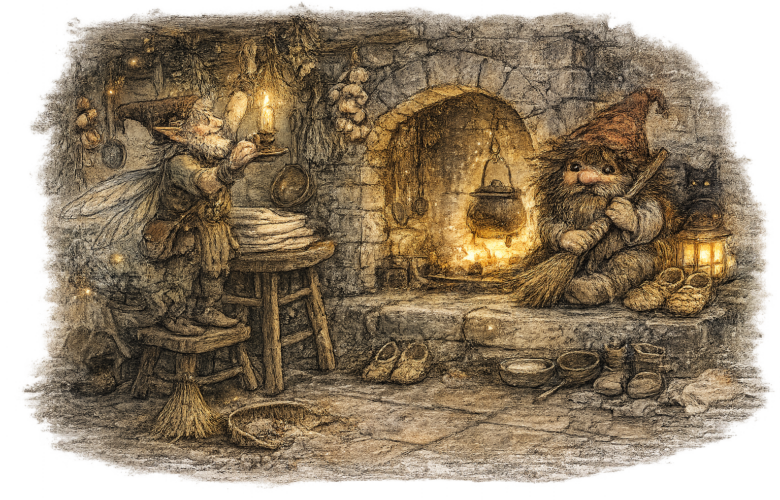
Tiny Maintenance Gods, Keepers of the Kindly “Done”
Wonderverse Charter (read aloud if you like):
- The Wonderverse tells the truth in a form you can hold.
- Nothing is forced, and nothing is wasted.
- Wonder is not denial. Wonder is courage with good lighting.
Where they live
Brownies and domovoi live in the places most myths forget to look: behind the broom, inside the drawer that jams, beneath the sink where the pipe makes its tiny complaint.
They thrive at the edge of habit. Not the dead kind, the living kind, the kind that carries you when your heart is tired. Their true habitat is not “the house.” It’s the ongoing relationship between you and your day.
In the Wonderverse, they maintain a whole district called Hearthwork, where the streets are paved with simple acts nobody applauded.
What they are
In plain terms, brownies and domovoi are:
- the psyche’s care infrastructure
- the mind’s stability sprites
- the body’s gentle logistics team
- the spirit of “put it back where it belongs” made small enough to be lovable
They are not perfectionists. They are not minimalists. They do not care how aesthetic your home is.
They care whether your space is kind to you.
What they do
They practice a craft called Maintenance Magic, which has three branches.
1) Repair
Not grand heroics. Small restorations that keep the world from feeling hostile.
They tighten loose cabinet knobs.
They coax the stuck zipper into cooperation.
They remind you that if you don’t wash the mug, tomorrow’s coffee will taste like yesterday’s neglect.
Repair is their way of saying: You deserve tools that work. You deserve a life with fewer unnecessary frictions.
2) Ritual
Brownies love repetition when it is infused with care.
A towel folded.
A counter wiped.
A candle lit before you sit down.
Shoes returned to their place like tiny animals coaxed back into their burrows.
They do not demand ritual. They offer it as a handrail.
3) Protection
Not from demons. From overwhelm.
They create “soft walls” that keep chaos from spilling everywhere. They help you contain your life into rooms you can actually live in.
A domovoi will happily stand guard at the boundary between “I’m tired” and “I will now reorganize my entire existence at 11:47 p.m.”
They are very brave.
How they communicate
They speak in a dialect called Nudge.
Nudge sounds like:
- “That would take thirty seconds.”
- “If you do it now, you’ll thank yourself.”
- “Make future-you’s path smoother.”
- “This isn’t a moral failing, it’s just a mess.”
They also communicate through tiny disruptions that feel like polite insistence:
- you can’t find your keys until you put yesterday away
- the drawer won’t close until you stop cramming your life into it
- your brain won’t settle until you clear one square foot of space
They are not punishing you. They’re trying to reduce your daily taxes.
What they want
They want care without shame.
Their favorite offerings:
- a dish washed gently, not angrily
- a floor swept like you’re blessing it
- one small reset before bed
- a cup of tea made with attention
- a “good enough” tidy that doesn’t become a self-judgment festival
They adore gratitude, but it must be practical. A brownie does not want a poem. A brownie wants you to stop stepping on Legos.
(They will accept a poem if it is written on a label maker.)
Their taboos
They have two.
1) Shame-Driven Order
If you clean because you hate yourself, the brownies go quiet. They won’t abandon you, but they’ll step back, like someone leaving the room when a conversation turns cruel.
Maintenance magic does not run on self-loathing. It runs on care.
2) False Urgency
Brownies respect true urgency. They do not respect the counterfeit kind: the frantic voice that claims you must do everything right now or the sky will fall.
If you start moving like a trapped animal, a domovoi may “misplace” something harmless to force you to pause. It’s not sabotage. It’s intervention.
The domovoi considers it community service.
Signs you’ve encountered them
You may have been visited if:
- you feel a sudden desire to make one small area pleasant
- you notice you’ve been living around a problem and decide to fix it
- you do a tiny task and feel an unexpected wave of relief
- you start leaving kindness for your future self like breadcrumbs
A stronger sign:
You begin to experience home not as a place you must earn, but as a state you can practice.
The Hearthwork Hazard List (gentle satire, for safety)
Possible side effects of brownie/domovoi contact include:
- becoming inexplicably fond of baskets
- developing opinions about hooks
- whispering “future me deserves this” like a spell
- realizing you don’t need discipline as much as you need systems
- discovering that “cleaning” is sometimes just grief with a broom
If symptoms persist, consult a friend.
Preferably one who will not suggest you “just try harder.”
Brownies hiss at that phrase.
A small ritual: The Kind Reset
This is for days when everything feels like too much.
- Choose one surface. One. Not the entire planet.
- Clear it slowly. Place items where they belong, or into one “later” basket.
- Wipe it like you’re welcoming someone you love.
- Add one comfort. Candle, cup, plant, soft cloth, a tiny object that says “you live here.”
- Close the ritual with a sentence:
“This is not punishment. This is care.”
Bonus offering (optional): set out a small snack for yourself. Brownies approve of snacks. They are practical mystics.
A vignette from the Wonderverse
In Hearthwork, there is a narrow street called Tomorrow. It runs along the edge of a district named Not Yet, and the lamplight there always feels a little softer.
A traveler entered Hearthwork carrying a sack labeled “I’ll deal with it later.”
The domovoi on duty, small as a loaf of bread and twice as serious, stepped into the road and raised a hand.
The traveler sighed. “I know. I know. I should have done this already.”
The domovoi frowned, as if the traveler had just insulted the concept of soup.
“Should,” the domovoi said, in a voice like a cupboard closing gently, “is a bad tool. It bends. It snaps. It cuts you.”
Then the domovoi produced a different tool: a little wooden bowl, warm to the touch, filled with something that smelled like comfort and onions.
“Eat,” said the domovoi. “Then do one thing.”
The traveler ate. The sack felt lighter. Not because it vanished, but because the traveler’s body came back online. One thing was done. Then another. The street called Tomorrow opened its gates without drama.
As the traveler left, the domovoi called after them:
“Tell future-you I said hello.”
And the traveler did, by putting the keys in the same place twice in a row, like someone learning a new kind of prayer.
Table of Contents
- Preface: How to Read a World That Isn’t “Real”
- Chapter 1: The Fae Folk
- Chapter 2: The Brownies and Domovoi
- Chapter 3: The Muses
- Chapter 4: The Djinn
- Chapter 5: The Selkies and Kelpies
- Chapter 6: The Golems
- Chapter 7: The Cauldron Spirits
- Chapter 8: The Oracles and Sibyls
- Chapter 9: The Trickster Kin
- Chapter 10: The Psychopomps
- Chapter 11: The Dryads and Greenwights
- Epilogue: The Taste of Returning

