
And Why It Might Change You Anyway
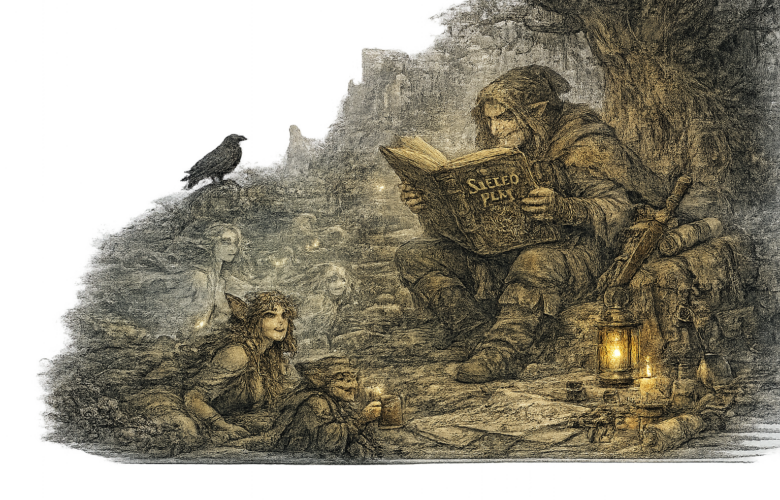
Welcome to The Wonderverse Field Guide.
If you came here hoping to prove that fae exist in the literal forest, or that a djinn is currently renting space in your attic, you may be disappointed. The Wonderverse is not trying to win an argument about the paranormal.
It’s trying to do something more useful.
It’s trying to give you a language for being human.
What you’ll find in these pages
This guide is a bestiary, yes, but not the kind that asks you to believe without evidence. The creatures here are symbolic lifeforms: myth-shaped ways of describing real inner experiences, real psychological patterns, real needs, real transitions, and real forms of healing.
Each chapter introduces a “species,” then explores:
- Where it lives (what inner terrain it shows up in)
- What it is (what it represents in human terms)
- What it does (the role it plays in your life, for better or worse)
- How it speaks (how you’ll recognize it)
- What it wants (what helps it become helpful rather than harmful)
- Its taboos (what makes it go sideways)
- Signs you’ve encountered it (the footprints it leaves behind)
- A gentle hazard list (because humor keeps the nervous system from locking the door)
- A small ritual (a practical action you can actually do)
- A vignette (a little story, because minds learn through story the way bodies learn through repetition)
This isn’t just lore. It’s a toolkit wearing a cloak.
Why myth, though?
Because your mind already speaks myth.
Even if you consider yourself deeply rational, your inner life is full of narratives, symbols, emotional weather, and “characters” that show up in predictable roles. Anxiety doesn’t arrive as a spreadsheet. It arrives as a feeling, a story, a threat forecast. Shame doesn’t appear as an argument. It appears as a voice, a posture, a shrinking.
Myth is how humans have always made the unseeable seeable.
Not because we’re irrational. Because we’re embodied, social animals whose brains evolved to compress complexity into meaning. Symbols are cognitive tools. Stories are memory machines. Metaphor is one of the ways we carry truth without dropping it.
The Wonderverse uses myth the way a microscope uses lenses: not to invent new reality, but to help you see what was already there.
“Symbolic” doesn’t mean “fake”
It means useful in a different way.
A map isn’t the territory, but it can still save your life.
These creatures are maps.
- A golem is not literally a clay giant, but many of us live with protective rules built in crisis that still guard us long after the crisis ends. Naming that part “golem” makes it easier to relate to it with gratitude instead of war.
- A psychopomp isn’t necessarily a ghostly ferryman, but transitions do require guidance, rituals, and companionship. When we personify that guidance, we can invite it, practice it, and offer it to others.
- A cauldron spirit isn’t a kitchen angel hovering over your stove, but transformation often is slow, warm, and time-dependent. Thinking in “simmering” terms helps you stop forcing healing into a deadline.
This is the point: symbolic beings create relationship.
And relationship is how change happens.
The psychological trick you’re allowed to use (on purpose)
Here’s a secret that has been hiding in plain sight since humans first told stories around fire:
You don’t have to believe a symbol is literal for it to work on you.
You only have to let it become a handle.
When you treat an inner pattern as a creature, you can do things that are hard to do with raw abstraction:
- You can notice it without becoming it.
- You can talk to it without surrendering to it.
- You can thank it without obeying it.
- You can set boundaries without self-hatred.
- You can practice new responses that feel less like punishment and more like care.
This guide is built to support that kind of change: gentle, concrete, sustainable.
What this book is not
To keep expectations honest, here’s what the Field Guide is not trying to do:
- It’s not trying to replace therapy, medicine, or professional support when you need it.
- It’s not trying to diagnose you.
- It’s not trying to convince you the supernatural is real.
- It’s not trying to sell you a certainty addiction dressed as spirituality.
The Wonderverse is not a religion. It does not demand belief. It invites exploration.
It asks for three things, and they show up everywhere in these pages:
- Consent (nothing is forced)
- Curiosity (we learn by exploring)
- Kindness (toward self and others, because cruelty is a dead-end road)
How to use the Field Guide
You can read this in at least four good ways:
- As stories
Just enjoy the creatures, the humor, the imagery, the strange warmth. Let it be a comfort book that sometimes bites gently. - As a mirror
When a chapter makes you feel seen, pause. Ask: “Where do I recognize this in myself?” The recognition is the doorway. - As a practice
Try the small rituals. They’re designed to be doable. Do one a day. Or repeat the same one for a week. The goal is not achievement. The goal is relationship. - As a shared language
If you’re in community, use these creatures as shorthand:
- “My golem is on duty today.”
- “I need a cauldron week, not a hustle week.”
- “This feels like a psychopomp moment.”
- “Can you be my brownie for five minutes and help me reset the room?”
It’s often easier to ask for help when you can name the shape of the need.
A note about transformation
If you let it, this book will do something slightly sneaky.
It will help you stop treating your inner life like an enemy state.
It will help you treat it like terrain.
And once you treat it like terrain, you can navigate.
You can return. You can repair. You can cross thresholds without pretending they don’t hurt. You can want things without worshipping them. You can laugh without cruelty. You can rest without guilt. You can practice wonder without denial.
That’s the whole aim of the Wonderverse: not escapism, but edible truth.
Reality is vast. Sometimes it’s too bright. Sometimes it’s unimaginably cold.
The Wonderverse doesn’t change those facts.
It changes your capacity to meet them.
So come in.
Bring your wonder.
And if you meet a fae, don’t ask it to prove it exists.
Ask it what it’s trying to help you notice.
Table of Contents
- Preface: How to Read a World That Isn’t “Real”
- Chapter 1: The Fae Folk
- Chapter 2: The Brownies and Domovoi
- Chapter 3: The Muses
- Chapter 4: The Djinn
- Chapter 5: The Selkies and Kelpies
- Chapter 6: The Golems
- Chapter 7: The Cauldron Spirits
- Chapter 8: The Oracles and Sibyls
- Chapter 9: The Trickster Kin
- Chapter 10: The Psychopomps
- Chapter 11: The Dryads and Greenwights
- Epilogue: The Taste of Returning

