
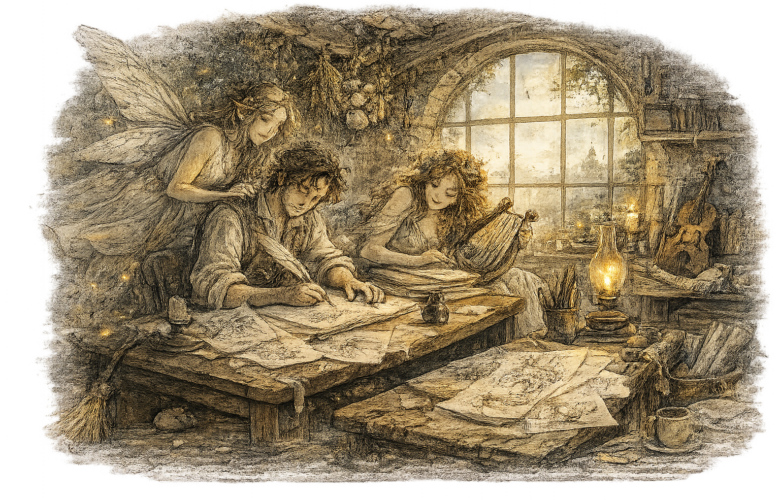
Idea-Pollinators, Keepers of the Useful Unfinished
Wonderverse Charter (read aloud if you like):
- The Wonderverse tells the truth in a form you can hold.
- Nothing is forced, and nothing is wasted.
- Wonder is not denial. Wonder is courage with good lighting.
Where they live
Muses live in the almost.
They inhabit the half-step between “I should make something” and “I’m making something,” that narrow bridge where most people turn around because the wind is judgment and the railings are missing.
In the Wonderverse, their territory is called The Pollenways, a sprawling garden-city built from unfinished beginnings. Its streets are named after drafts: First Draft Avenue, Bad Idea Boulevard, Not Sure Yet Lane, and a small cul-de-sac called Delete Later.
Muses adore doors that are cracked open.
They do not often enter closed rooms.
What they are
If fae are the spark-editors of attention, muses are the cross-pollinators of meaning.
In plain terms, they’re:
- the psyche’s association engine wearing a flower crown
- the mind’s pattern-bridgers
- the body’s creative weather given wings
- the presence that says, “Combine those two things. Trust me.”
They are not “talent.” They are not “genius.” They are not proof that you are special or unworthy.
They are proof that your mind is alive and hungry.
What they do
Muses practice a craft called Pollination, which has three branches.
1) Seed
They drop tiny beginnings that are not yet responsible for being good.
A phrase.
A rhythm.
A single image.
A question with a hook in it.
The seed is designed to be carried, not solved. It makes a pocket in your mind and sits there, warm, until you return.
2) Splice
Muses love improbable marriages.
They take:
- a memory you didn’t think mattered
- a line you overheard in a store
- a moment of anger
- a science fact
- a childhood smell
and braid them into a new thing that feels inevitable after it exists.
Splice is the muse’s signature move: the surprise that makes sense.
3) Release
They loosen your grip.
They are gentle saboteurs of perfectionism. They open the cage door of “the right way,” and sometimes you step out. Sometimes you don’t. They don’t punish you.
They simply keep opening doors until you remember your own legs.
How they communicate
Muses speak in a dialect called Humming.
Humming sounds like:
- a line that repeats until you write it down
- an urge to make a thing for no reason you can explain
- “what if…” that arrives with a grin
- a sudden clarity while doing something boring
They also communicate through disruptions that are oddly kind:
- you can’t focus until you take a walk
- your thoughts keep circling one image until you sketch it
- you find yourself rearranging words in your head like furniture
Sometimes they speak through other creatures. A fae might hand them a spark. A brownie might clear a workspace. A trickster might knock your ego off its pedestal so your hands can move again.
Muses are collaborative.
They do not care who gets credit.
(Your ego will hate this. Your art will thrive on it.)
What they want
Muses want movement.
Not fast. Not polished. Just real.
Their favorite offerings:
- ten minutes of beginning
- a bad first draft written on purpose
- a melody hummed into your phone at 2 a.m. without apology
- a messy sketch that exists only to prove you are not dead
- curiosity that doesn’t demand immediate payoff
They are especially fond of this phrase:
“I’ll make it small enough to start.”
That sentence is basically a summoning circle.
Their taboos
They have two.
1) Performance as Primary Food
If you create mainly to be seen, the muses get bored. Not angry, just… bored.
They will still visit you occasionally because they’re not cruel. But they won’t move in.
Muses are wild creatures. They require a habitat called privacy.
2) The Lie of “Someday”
Someday is a fake calendar.
It is printed on the same paper as “when I’m finally ready” and “once my life calms down,” which is paper that dissolves in the first rain.
Muses are allergic to Someday. They sneeze. You procrastinate.
This is not a coincidence.
Signs you’ve encountered them
You may have been visited if:
- you feel a sudden urge to make something, even tiny
- you catch yourself jotting notes like you’re stealing from your own future
- you’re delighted by a connection you didn’t force
- you feel less pressure to be “good” and more desire to be honest
- you start collecting fragments as if they matter (because they do)
A stronger sign:
You become willing to be a beginner again, which is the most powerful creative posture on Earth.
The Pollenways Hazard List (gentle satire, for safety)
Possible side effects of muse contact include:
- purchasing notebooks you do not need
- recording voice memos titled “idea” (there will be seventeen)
- becoming intolerant of meetings that could have been an email
- thinking about your project while brushing your teeth
- feeling suspiciously alive for no measurable reason
If symptoms persist, do not seek immediate relief.
Relief is overrated.
Make something small and see what happens.
A small ritual: The Ten-Minute Offering
This ritual is designed to bypass the bouncer named “Motivation.”
- Set a timer for ten minutes. Ten. Not thirty. Not the rest of your life.
- Choose a container: page, voice memo, instrument, sketchpad, document.
- Make one ugly beginning. A line. A chord. A sentence. A shape.
- When judgment speaks, name it kindly: “Hello, Judge. You can sit in the corner.”
- Stop when the timer stops. Leave a breadcrumb for tomorrow: one note about the next tiny step.
Close with the sentence:
“I am not proving anything. I am practicing being alive.”
A vignette from the Wonderverse
In the Pollenways there is a greenhouse called Not Yet, and inside it grow plants that look like ideas before they decide what they are.
A traveler wandered in with empty hands and a tired face.
“I used to make things,” the traveler told the gardener, who was neither young nor old, neither man nor woman, neither human nor not. The gardener’s sleeves were stained with ink and soil.
The gardener nodded without pity. “And now?”
“Now,” said the traveler, “everything I make feels pointless.”
The gardener lifted a small watering can and poured a thin stream onto a pot of bare dirt. Nothing happened.
The traveler frowned. “That’s it? You’re watering nothing.”
The gardener smiled like someone who has survived themselves. “I’m watering a beginning.”
The traveler looked closer. The dirt was not empty. In its center was a speck no larger than a comma.
“A comma?” the traveler asked.
“A pause,” said the gardener. “A place where something can be added.”
The traveler sighed. “But what if it never becomes anything? What if I’m just… wasting time?”
The gardener set the can down and leaned in, conspiratorial. “Time is being wasted whether you make something or not. The question is what you want it to taste like.”
In the corner of the greenhouse, a muse perched on a beam, swinging its legs. It looked like a swallow made of paper, ink-veined wings fluttering with impatience.
The traveler didn’t see it, at first. The traveler’s eyes were still trained on outcomes, the way survival teaches.
The gardener reached into a drawer and pulled out a single blank page. Not a notebook. Not a plan. One page.
“Here,” they said. “Write the worst first line you can.”
The traveler laughed, a small startled sound, like a door unlocking.
They wrote:
This is stupid and I don’t know what I’m doing.
The muse’s wings shivered in delight.
The gardener nodded. “Excellent. Now you’ve told the truth in a form you can hold.”
The traveler stared at the line. Something in their chest loosened, not into happiness exactly, but into room.
“What next?” they asked.
The gardener pointed at the comma-seed in the dirt. “Now you add one more mark. One more breath. One more note.”
The traveler hesitated, then wrote a second line, not good, not polished, but real.
And in the pot, beneath the soil, something answered by deciding to exist.
Above them, the paper-swallow muse launched into the air and began to circle, humming, as if to say:
Yes. Like that. Again.
Table of Contents
- Preface: How to Read a World That Isn’t “Real”
- Chapter 1: The Fae Folk
- Chapter 2: The Brownies and Domovoi
- Chapter 3: The Muses
- Chapter 4: The Djinn
- Chapter 5: The Selkies and Kelpies
- Chapter 6: The Golems
- Chapter 7: The Cauldron Spirits
- Chapter 8: The Oracles and Sibyls
- Chapter 9: The Trickster Kin
- Chapter 10: The Psychopomps
- Chapter 11: The Dryads and Greenwights
- Epilogue: The Taste of Returning

