
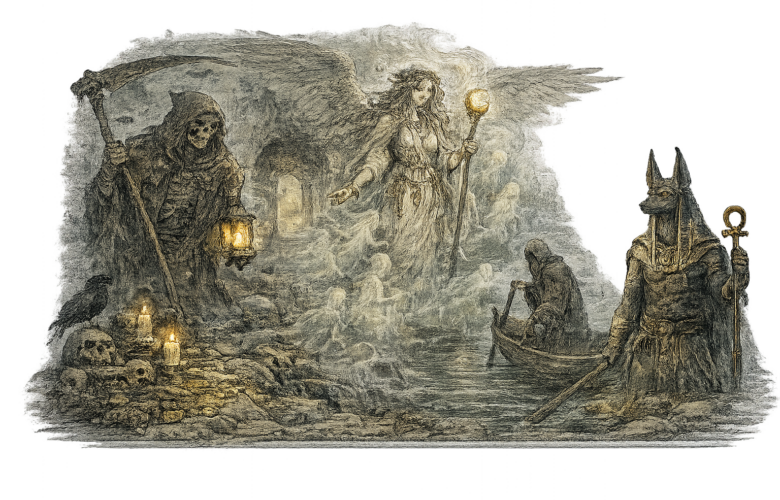
Threshold Guides, Keepers of the Lantern Door
Wonderverse Charter (read aloud if you like):
- The Wonderverse tells the truth in a form you can hold.
- Nothing is forced, and nothing is wasted.
- Wonder is not denial. Wonder is courage with good lighting.
Where they live
Psychopomps live at thresholds.
Not only death, though that is the threshold people dramatize because it makes good stories and keeps denial fed. Psychopomps live at every ending and every beginning:
- leaving a job
- ending a relationship
- becoming someone new
- grieving a version of yourself
- stepping out of a belief
- crossing from “I can’t” into “I might”
In the Wonderverse, their territory is called The Lantern Door, a vast network of passageways and gates where the air smells like rain on stone and the silence feels steady, not empty.
Every doorway there has a lamp beside it.
Not to banish darkness. To make the darkness navigable.
What they are
In plain terms, psychopomps are:
- the psyche’s transition intelligence
- the mind’s grief-companion with a compass
- the part of you that can walk forward without pretending it isn’t sad
- a form of courage that doesn’t shout
They are not grim reapers. They are not punishers. They do not drag anyone.
Their signature ethic is simple:
Consent is the gate.
If you are not ready, they wait beside you like a lantern that refuses to go out.
What they do
They practice a craft called Passagework, which has three branches.
1) Witness
They stay with you while you feel what you would rather skip.
Witness is not therapy-speak in the Wonderverse. It’s an action: standing beside a trembling truth without flinching.
They don’t fix your grief.
They make room for it so it can move.
2) Carry the Light
Psychopomps don’t remove darkness. They provide orientation.
They help you see:
- what is ending
- what is still alive
- what must be honored
- what must be released
- what is safe to take with you
Their lanterns are not bright spotlights. They are warm circles of light, just enough for the next step.
3) Guide
They escort.
Not as commanders, as companions. They walk at your pace. They adjust to your breath.
Sometimes guiding looks like:
- reminding you to eat
- helping you say goodbye properly
- steering you away from self-destruction disguised as “moving on”
- whispering, “One more step,” when you want to lie down on the threshold and become furniture
They are fiercely gentle.
How they communicate
Psychopomps speak in a dialect called Quiet.
Quiet sounds like:
- “This matters.”
- “Take your time.”
- “Not that way.”
- “Here. Breathe.”
- “You’re not alone.”
They also communicate through:
- dreams of doors, bridges, trains, boats, crossroads
- recurring images of lanterns, ravens, black dogs, foxes, moths
- the sudden urge to simplify
- a calm clarity that arrives after tears
Their presence often feels like:
A hand near your shoulder, not touching.
A steady light in peripheral vision.
A kind firmness that keeps you from spiraling into the ditch.
What they want
Psychopomps want honest endings.
Their favorite offerings:
- a goodbye said clearly
- a ritual of release, even a tiny one
- permission to grieve without calling it weakness
- willingness to take one step instead of demanding a map of the whole road
- a promise to treat yourself gently in transition
They love when you say:
“I will not rush my crossing.”
That sentence is a lantern wick.
Their taboos
They have two.
1) Skipping the Goodbye
When you refuse to acknowledge an ending, it follows you like a shadow you keep tripping over.
Psychopomps do not demand drama. They demand honesty.
If you try to sprint past grief, they will quietly place a chair in your path.
Not to punish you.
To make you sit long enough to feel what needs to be felt.
2) Violence Toward the Self
Transitions can make people cruel to themselves. They call it discipline. They call it “getting over it.” They call it strength.
Psychopomps call it what it is: harm.
They will not guide you across a threshold by letting you bleed out on the stones.
They will stop you, gently or firmly, and say:
“Not like that.”
Signs you’ve encountered them
You may have been visited if:
- you feel supported in a sad moment without knowing why
- you find yourself making simple, grounding choices during chaos
- you feel drawn to candlelight, quiet music, slow walks
- you sense a clear “this is over” without bitterness
- you can imagine a future again, even faintly
A stronger sign:
You stop asking “How do I get rid of this feeling?” and start asking “How do I walk with it?”
That question opens the Lantern Door.
The Lantern Door Hazard List (gentle satire, for safety)
Possible side effects of psychopomp contact include:
- crying in a way that feels like weather passing through
- saying goodbye to people who are still alive (awkward, but sometimes necessary)
- becoming suspicious of “closure” as a product
- discovering that grief is just love with nowhere to go
- gaining a strange tenderness for your past selves
If symptoms persist, do not attempt to numb them into silence.
Psychopomps can work with pain.
They cannot work with denial wrapped in productivity.
A small ritual: The Lantern Step
Use this when you’re on a threshold and feel frozen.
- Light something. Candle, phone light, lamp. Make literal light.
- Name the threshold. “This is an ending.” “This is a beginning.” “This is both.”
- Name what you’re leaving behind in one sentence.
- Name what you’re carrying forward in one sentence.
- Take one small step that honors the crossing: a message sent, a bag packed, a dish washed, a walk taken.
Close with the sentence:
“I cross with kindness.”
A vignette from the Wonderverse
At the Lantern Door there is a gate called After, and it is smaller than people expect.
A traveler stood before it with hands full of things they couldn’t stop carrying: old letters, a cracked photograph, a handful of “what if,” and the heavy key of a life that no longer fit the lock.
Behind them was a door labeled Before.
It was open, inviting, familiar, full of echoes.
In front of them, the gate called After waited without pleading.
A psychopomp approached, quiet as a shadow that means well. It took the shape of a black dog with a lantern hanging from its collar. The lantern’s light didn’t push against the dark. It simply existed inside it.
The traveler’s voice came out rough. “I don’t want to go,” they said.
The dog sat.
No argument. No pep talk. Just presence.
The traveler swallowed. “Everyone keeps telling me it’s time.”
The dog’s lantern warmed slightly, as if to say: Time is not a whip.
The traveler looked down at the clutter in their hands. “If I go through, I lose this.”
The psychopomp tilted its head.
The traveler clarified, desperate. “I lose who I was. I lose what I thought would happen. I lose the story.”
The dog stood and walked to the gate. There, carved into the stone, were two lines the traveler hadn’t noticed:
Nothing is forced.
Nothing is wasted.
The traveler’s eyes stung. “It feels wasted.”
The psychopomp turned back. In its gaze was a steady refusal to lie.
Then it did something unexpected.
It nudged a small wooden box toward the traveler with its nose.
The box had a lid and a latch.
The traveler stared. “What’s that?”
The psychopomp’s voice, when it came, was not a voice so much as a meaning placed gently in the air:
A reliquary. For what you truly need to keep.
The traveler’s hands trembled as they opened the box.
Inside was space. Clean and honest.
“What do I put in it?” the traveler whispered.
The psychopomp’s lantern flickered, and in the light the traveler suddenly knew.
Not the entire story.
Just the essence.
They placed into the box:
- one lesson
- one love
- one memory that still felt warm
- one promise to themselves they didn’t want to break again
The rest, the letters and the “what if,” the cracked photograph of a future that never happened, stayed in their hands.
The traveler looked at the dog. “But what about these?”
The psychopomp did not answer with words.
It walked to the threshold and waited.
The traveler stood there for a long moment. Then, with a soft sob that felt like surrender and respect at the same time, they set the extra weight down on the stones beside Before.
Not thrown. Not rejected. Placed.
The psychopomp returned, nudged the reliquary box gently, and the traveler clutched it to their chest.
“Will it hurt?” the traveler asked.
The dog’s gaze said: Yes.
Then, just as clearly: And you will live.
The traveler took a breath, stepped forward, and passed through After.
The gate did not slam behind them. It did not lock. It simply stood, a threshold honored.
On the other side, the air felt different. Not better. Not worse. Just new.
The traveler looked down. The reliquary was still in their arms, warm as a heartbeat.
The psychopomp walked beside them, lantern swinging, and for the first time the traveler realized:
Guidance doesn’t always feel like answers.
Sometimes it feels like being accompanied while you become.
Table of Contents
- Preface: How to Read a World That Isn’t “Real”
- Chapter 1: The Fae Folk
- Chapter 2: The Brownies and Domovoi
- Chapter 3: The Muses
- Chapter 4: The Djinn
- Chapter 5: The Selkies and Kelpies
- Chapter 6: The Golems
- Chapter 7: The Cauldron Spirits
- Chapter 8: The Oracles and Sibyls
- Chapter 9: The Trickster Kin
- Chapter 10: The Psychopomps
- Chapter 11: The Dryads and Greenwights
- Epilogue: The Taste of Returning

