
“Why don’t they just try harder?”
It’s a question we’ve all asked—about coworkers, family members, students, even ourselves. At first glance, it seems simple. If someone isn’t doing what they “should” be doing, they must be lazy. Right?
But what if “laziness” isn’t the problem at all?
What if it’s a symptom?
What if, instead of a moral failure, laziness is a misunderstood signal—one that tells us something deeper is going on beneath the surface?
The Myth of Laziness
“Laziness” is one of those labels that ends conversations instead of opening them. It’s often used as a shorthand for “this person isn’t doing what I expect,” or “I feel frustrated and don’t understand why this is happening.”
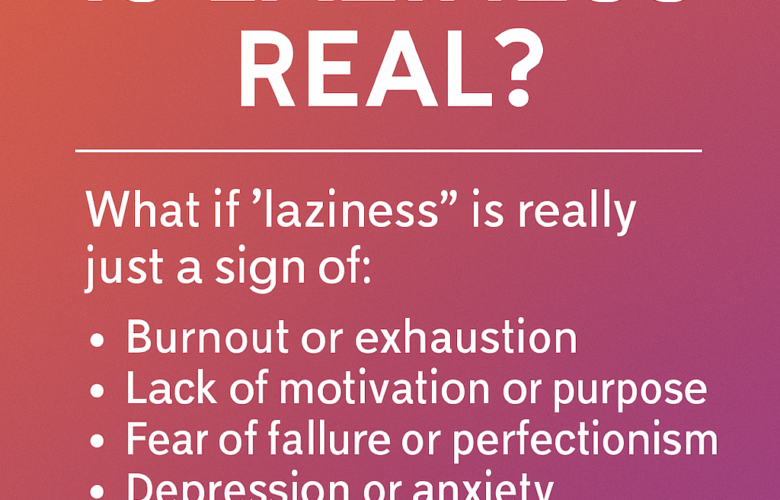
But when we look closer, we find that what we call laziness is often:
- A brain and body in survival mode
- A person overwhelmed by fear, pressure, or hopelessness
- A mismatch between environment and neurotype
- A symptom of burnout or unmet needs
- A cry for rest, meaning, or support
In other words, laziness is rarely about not caring or not trying. It’s more often about struggling.
Why People Seem “Lazy”
1. Unmet Psychological Needs
Motivation thrives when we feel three things: autonomy, competence, and connection. If a person lacks control over their choices, doubts their abilities, or feels isolated, their motivation naturally drops. It’s not laziness—it’s disempowerment.
2. Fear and Perfectionism
Sometimes, people care so much that they’re terrified of failing. The fear of “not doing it right” can lead to avoidance. It’s not laziness—it’s a survival strategy in disguise.
3. Neurodivergence
ADHD, autism, and other neurodivergent traits can affect executive function—the brain’s ability to plan, start, and follow through. Tasks others find easy can feel like climbing a mountain. It’s not laziness—it’s a different wiring.
4. Depression and Mental Health Challenges
Depression can drain energy, flatten motivation, and turn everyday tasks into heavy burdens. Anxiety can paralyze decision-making. Trauma can trigger shutdown. It’s not laziness—it’s mental distress.
5. Burnout
People who care deeply and work hard are especially prone to burnout—especially in environments that demand too much and give too little. When the tank is empty, even basic tasks feel impossible. It’s not laziness—it’s exhaustion.
6. Meaning and Alignment
Humans are wired for meaning. If a task feels pointless, unethical, or disconnected from a person’s values, it’s hard to care. That’s not laziness—it’s a clue about what matters.
So What Can We Do?
If we replace judgment with curiosity, we unlock new ways of helping ourselves and others move forward. Here are practical strategies to work with our limits and struggles—rather than pretending they don’t exist.
1. Start With Needs
Before trying to push through, ask:
- Have I eaten, slept, hydrated?
- Am I emotionally safe right now?
- What kind of support do I need?
Sometimes “doing nothing” is exactly what the body and mind need before they can engage again.
2. Shrink the Task
- Break it into smaller parts
- Start with just two minutes
- Celebrate any progress, no matter how small
Overwhelm leads to shutdown. Momentum starts with one tiny step.
3. Use Support Structures
- Try the Pomodoro technique (25 minutes work, 5 minutes break)
- Co-work with someone (body doubling)
- Use external rewards or accountability
Motivation doesn’t have to come from within—it can be borrowed.
4. Make It Meaningful
- Connect the task to your values or goals
- Add music, humor, or creativity
- Pair it with something enjoyable (e.g., cleaning while listening to a podcast)
Even dull tasks can become meaningful—or at least more tolerable.
5. Reduce Friction
- Set up your environment for success
- Automate or delegate where possible
- Eliminate distractions or decision fatigue
The less energy it takes to start, the more likely you’ll begin.
6. Honor Your Brain
- Find your most productive times of day
- Work in bursts, not marathons
- Create routines that suit you, not what others expect
If your brain doesn’t work like everyone else’s, that’s not failure—it’s diversity.
7. Practice Self-Compassion
What you say to yourself matters. Replace “I’m so lazy” with:
- “This is hard right now, and that’s okay.”
- “I can do this in small steps.”
- “Struggling doesn’t mean I’m failing.”
Shame rarely motivates—kindness does.
8. Get Help When Needed
If nothing seems to help, or you’re stuck in a loop of avoidance and shame, reach out. Therapy, coaching, and support communities can offer tools and compassion you don’t have to figure out alone.
When We Stop Calling People Lazy
When we stop calling people lazy, we start asking better questions:
- What’s actually making this hard?
- What do you need right now?
- How can we work with what is instead of pretending it’s not there?
And when we do that, something shifts. Motivation isn’t forced—it’s fostered. Growth isn’t demanded—it’s supported. People don’t just survive. They begin to thrive.
Helpful Resources
Here’s a collection of tools, articles, and communities that go deeper into motivation, neurodivergence, executive function, and self-compassion:
Articles & Videos
- “Laziness Does Not Exist” by Dr. Devon Price (Medium)
- TED Talk: “The Power of Vulnerability” by Brené Brown
- “Executive Dysfunction Explained” (ADDitude Magazine)
- “Self-Compassion” by Dr. Kristin Neff
Tools & Strategies
- Focusmate – Body Doubling for Productivity
- Notion or Todoist – Task Management with Flexibility
- The Pomodoro Technique – Simple Time Management
- Habitica – Gamify Your Habits
Support & Community
- ADDA – Attention Deficit Disorder Association
- Neurodivergent Insights on Instagram
- 7 Cups – Free Support Chat with Trained Listeners
- The Mighty – Real Stories from People Living with Mental Health Challenges
If this helped shift your view of “laziness,” consider sharing it. You never know who might be quietly blaming themselves for something that’s not their fault—and who just needs a little compassion to begin again.

