
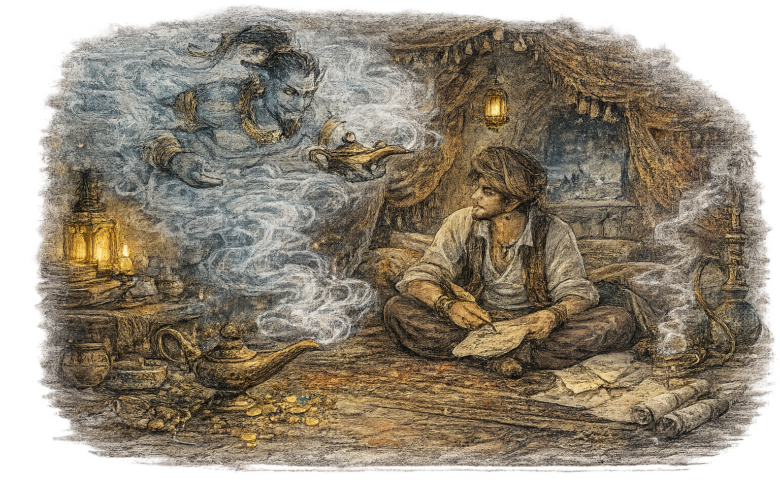
Wish-Pressure Spirits, Keepers of the Unsplit Want
Wonderverse Charter (read aloud if you like):
- The Wonderverse tells the truth in a form you can hold.
- Nothing is forced, and nothing is wasted.
- Wonder is not denial. Wonder is courage with good lighting.
Where they live
Djinn live where desire gets hot.
Not “hot” like romance alone, though they can wear that mask when it’s convenient. Hot like friction. Like wanting. Like the nervous system leaning forward.
They dwell in the Wonderverse region called The Furnace of Want, a city of brass corridors and shimmering vents, where thoughts don’t drift politely. They boil. The air there tastes like cinnamon, ozone, and decisions you’ve been postponing.
The Furnace is not a punishment realm. It’s a forge.
It exists because wanting is not a flaw. Wanting is energy. It can burn you, yes. It can also build you.
What they are
In plain terms, djinn are:
- the psyche’s desire made audible
- the mind’s truth pressure
- the part of you that refuses to be lied to, even by you
- an ancient negotiation between your longing and your fear
Djinn are not wish-granting vending machines. That story is a warning written by people who wanted outcomes without honesty.
A djinn does not grant the wish you say. A djinn reveals the wish you mean.
And it will often ask, very calmly:
“Do you want this, or do you want what you think this will give you?”
What they do
Djinn practice a craft called Clarifying Fire, which has three branches.
1) Separate
They split “taped-together wishes.”
Many wishes are really two wishes wearing one coat:
- “I want success” and “I want safety.”
- “I want love” and “I want to stop being alone with myself.”
- “I want to be seen” and “I don’t want to be judged.”
- “I want change” and “I want nothing to change.”
Djinn separate them gently, the way a careful hand untangles a necklace.
Not to shame you. To free you.
2) Temper
They help you hold desire without becoming devoured by it.
Desire is a flame. If you smother it, you go cold. If you feed it recklessly, you burn down your own house.
Djinn teach the art of tending: adding air, removing fuel, waiting until the metal is ready.
They do not remove longing. They teach it manners.
3) Transmute
They turn “want” into direction.
Want, undirected, becomes hunger with teeth. Want, translated, becomes choice.
A djinn might say:
- “What if you don’t need the whole feast? What if you need one honest bite?”
- “What if the thing you crave is not the object, but the feeling of permission?”
- “What if you’re trying to buy with accomplishment what only belonging can give?”
They do not give you what you want.
They help you become someone who can want wisely.
How they communicate
Djinn speak in a dialect called Bargain.
Bargain sounds like:
- questions that feel like doors
- uncomfortable clarity that arrives without drama
- the sense of being seen through, without being mocked
- “If you choose this, you also choose that”
They also communicate through:
- sudden impatience with your own half-truths
- recurring fantasies that won’t die
- jealousy that points like an arrow (not a sin, a signal)
- a longing so specific it almost has a taste
Djinn do not shout unless you refuse to listen for a long time.
Even then, they often shout by going silent.
What they want
Djinn want consent with eyes open.
Their favorite offerings:
- one desire named precisely
- one fear admitted without theatrics
- one choice made without begging the universe to make it for you
- one boundary set as an act of self-respect, not self-protection
They love when you say:
“I can want this without worshipping it.”
That sentence is a cooling charm.
Their taboos
They have two.
1) The Lie of Pure Motives
People like to believe they want things for noble reasons only. Djinn find this adorable.
Desire is rarely pure. It’s mixed. It’s human. It contains beauty and ego and fear all tangled together like earbuds in a pocket.
Djinn do not punish mixed motives. They punish pretending you don’t have them.
Because pretending is what makes wishes go sideways.
2) Outcomes Without Ownership
If you want the result but refuse responsibility for the path, djinn become… difficult.
Not cruel. Pedantic.
They will present you with a series of tiny mirrors until you either:
- take the wheel, or
- stop asking for the car to drive itself into your dream.
Djinn respect longing. They do not respect helplessness performed as spirituality.
Signs you’ve encountered them
You may have been visited if:
- you can suddenly name what you want without apologizing for wanting it
- you realize your “goal” is a proxy for something more tender
- you feel the heat of desire, and it doesn’t scare you as much
- you stop bargaining with fate and start bargaining with yourself honestly
A stronger sign:
You begin to experience choice as power, not pressure.
The Furnace Hazard List (gentle satire, for safety)
Possible side effects of djinn contact include:
- quitting things you secretly hated
- telling the truth in conversations where you used to perform
- realizing your “dream life” includes naps
- discovering you don’t want what you thought you wanted (rude, but useful)
- feeling grief for the self you tried to become to earn love
If symptoms persist, do not attempt to extinguish them with distractions.
Djinn are not fooled by scrolling.
They will wait. They are excellent at waiting.
A small ritual: The Unsplit Wish
This ritual is for when you’re caught between craving and fear.
- Write the wish you keep repeating. The headline version.
- Ask: “What do I believe this will give me?” Write the answer.
- Ask: “What am I afraid will happen if I get it?” Write the answer.
- Split it into two wishes. For example: “I want success” and “I want safety.”
- Choose one tiny action that honors one wish today without betraying the other.
Close with the sentence:
“I will not outsource my life to a fantasy of certainty.”
A vignette from the Wonderverse
In the Furnace of Want, there is a corridor called Almost, and it is lined with doors that look identical until you touch them.
A traveler arrived there carrying a jar.
Inside the jar was a small flame, bright and restless. The traveler held it like evidence.
“I found this,” the traveler said, to the djinn who stood at the corridor’s end.
The djinn was not a towering genie. Not a spectacle. It looked, absurdly, like a person made of warm air and old gold, edges shimmering as if it had been poured from a bell.
“What is it?” the djinn asked.
“My desire,” said the traveler, as if confessing a crime.
The djinn tilted its head. “For what?”
The traveler lifted the jar. “For success.”
The djinn’s eyes softened in a way that made the traveler uneasy, like being understood too quickly.
“Open the jar,” said the djinn.
The traveler’s grip tightened. “If I open it, it might get bigger.”
“Yes,” said the djinn, simply.
“And it might burn me.”
“Yes,” said the djinn again, still calm.
The traveler stared at the flame as if it had personally betrayed them. “So what do I do?”
The djinn stepped closer, and the air around it smelled like cloves and rain on hot stone.
“First,” it said, “tell the truth. Not the polished one. The living one.”
The traveler swallowed. “I want to be seen,” they said, and the jar rattled.
The djinn nodded. “Go on.”
“I want to matter,” said the traveler, and the flame surged against the glass.
“I want… to stop feeling like I have to earn the right to exist.”
The djinn’s expression did not change. It did not applaud. It did not pity.
It only said, very gently, “There it is.”
The traveler’s eyes stung. “So why does it feel like success is the only door?”
The djinn touched the jar, and the glass warmed without cracking.
“Because you’ve taped two wishes together,” it said. “One is a wish for expression. One is a wish for belonging.”
The traveler blinked. “Those are different?”
“Different,” said the djinn, “and they require different foods.”
The djinn gestured down the corridor. Two doors appeared where there had been one, each with a different handle.
On the first door, a brass plate read: Make the Thing.
On the second, it read: Let Yourself Be Loved.
The traveler stared, breath caught, like someone who has just realized they’ve been trying to drink soup with a fork.
“But,” they whispered, “what if I choose wrong?”
The djinn’s smile was small and fierce. “Then you will learn. That is not wrong. That is life.”
The traveler hesitated, then set the jar down and opened it.
The flame rose into the air, taller now, but it didn’t lunge. It hovered, waiting, like a loyal animal that has been treated as a threat for too long.
The traveler reached toward the first door.
The djinn did not push. It only held its hand near the traveler’s shoulder, not touching, a presence like a lantern in a corridor.
“Consent,” the djinn murmured, and the corridor brightened.
The traveler turned the handle.
And the Furnace, which had always been loud, grew quiet enough to hear the sound of a life being claimed.
Table of Contents
- Preface: How to Read a World That Isn’t “Real”
- Chapter 1: The Fae Folk
- Chapter 2: The Brownies and Domovoi
- Chapter 3: The Muses
- Chapter 4: The Djinn
- Chapter 5: The Selkies and Kelpies
- Chapter 6: The Golems
- Chapter 7: The Cauldron Spirits
- Chapter 8: The Oracles and Sibyls
- Chapter 9: The Trickster Kin
- Chapter 10: The Psychopomps
- Chapter 11: The Dryads and Greenwights
- Epilogue: The Taste of Returning

