
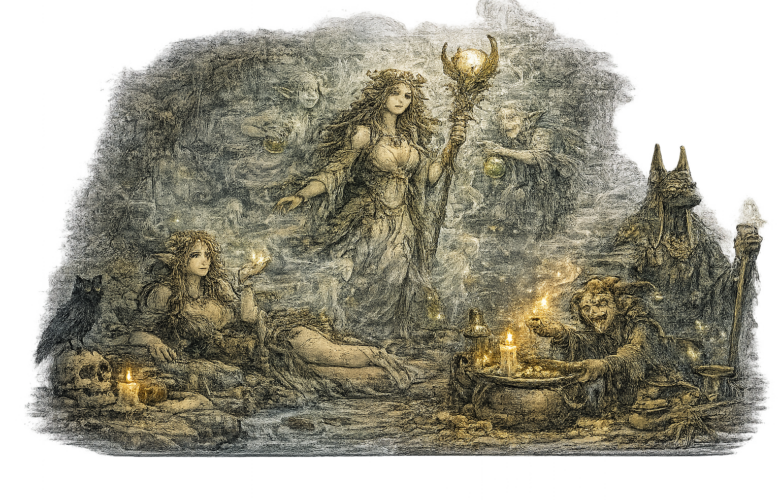
Transformers, Compost-Angels, Keepers of Slow Magic
Wonderverse Charter (read aloud if you like):
- The Wonderverse tells the truth in a form you can hold.
- Nothing is forced, and nothing is wasted.
- Wonder is not denial. Wonder is courage with good lighting.
Where they live
Cauldron spirits live where things become.
They dwell in kitchens and gardens and graveyards of old selves. They live in the warm dark beneath the surface, where time does its quiet work. In the Wonderverse, their home region is called The Simmerlands, a broad valley of steaming pots and compost heaps, moonlit herb beds, and slow-turning mills.
The air there smells like thyme, wet earth, and tears that have finally been allowed to fall.
The Simmerlands are not dramatic. They are not flashy. They do not care about your timeline.
They are devoted to transformation that lasts.
What they are
In plain terms, cauldron spirits are:
- the psyche’s integration system wearing an apron
- the mind’s metabolizers of pain
- the body’s slow repair given mythic form
- the force that says, “Yes, this is heavy. We can carry it differently.”
They are not here to “fix” you, because they do not agree that you are broken.
They are here to help you turn experience into nourishment.
Some people call them witches. Some call them ancestors. Some call them the unconscious. Some call them “that weird thing that happens when I finally rest.”
In the Wonderverse, they are simply what they are:
Compost-angels.
What they do
They practice a craft called Simmerwork, which has three branches.
1) Soften
They loosen what has hardened inside you.
Shame, especially, arrives like a stone. Cauldron spirits do not smash it. They soak it. They warm it. They sit with it until it remembers it’s made of feelings, not fate.
Soften is the first mercy: making room.
2) Ferment
They turn raw experience into wisdom you can actually use.
Fermentation is not instant. It’s a relationship between time and containment. You don’t “get over” something. You let it change inside you until it becomes something else.
A cauldron spirit will happily say, “We are not done with that yet,” and mean it as comfort.
3) Feed
They convert transformed material into nourishment.
Not positivity. Not platitudes. Actual usable nourishment:
- insight that changes a pattern
- tenderness that returns your breath
- boundaries that stop being emergency measures and become self-respect
- a grief that becomes a reservoir of love instead of a sinkhole
Feed is their final art: turning the past into something that strengthens you.
How they communicate
Cauldron spirits speak in a dialect called Steam.
Steam sounds like:
- the body finally exhaling
- emotions rising in waves when you stop bracing
- sudden hunger, thirst, fatigue, the honest messages of a nervous system recovering
- the urge to make soup, tea, bread, anything that says “warmth is allowed here”
They also communicate through dreams:
- old rooms being cleaned
- water running clear
- seeds sprouting in strange places
- you carrying a heavy pot and realizing you can set it down
Steam doesn’t demand. It invites.
It fogs the mirror long enough for you to stop judging your face.
What they want
Cauldron spirits want time with permission.
Their favorite offerings:
- rest that isn’t earned
- a slow meal eaten like you belong on the planet
- journaling that tells the truth without turning it into a performance
- a tiny ritual repeated daily, not to “improve,” but to be kind
- willingness to grieve without trying to outrun it
They love when you say:
“I will let this take the time it takes.”
That sentence is a lid placed gently on the pot.
Their taboos
They have two.
1) Forced Healing
Trying to heal on a schedule makes the cauldron spirits go quiet. Not punitive. Just… irrelevant. You can’t ferment bread by yelling at it.
When people insist “I should be over this by now,” the Simmerlands become colder.
Not because the spirits withdraw love, but because the nervous system hears the word should and tightens, and tightness is the enemy of transformation.
2) Spiritual Bypassing
Bright sayings used to avoid dark truths.
Cauldron spirits do not hate hope. They hate hope used as a muzzle.
If you keep trying to paint the mold instead of cleaning it, the cauldron spirits start handing you stronger soap.
Gently. Relentlessly.
Signs you’ve encountered them
You may have been visited if:
- you find yourself crying and it feels cleansing rather than catastrophic
- you feel drawn to warmth, softness, and slow rituals
- you suddenly understand a past pain without defending yourself from it
- you begin to treat yourself like someone worth caring for
- you notice shame loosening its grip, even slightly
A stronger sign:
You stop asking “What’s wrong with me?” and start asking “What happened to me, and what do I need now?”
That shift is cauldron magic.
The Simmerlands Hazard List (gentle satire, for safety)
Possible side effects of cauldron spirit contact include:
- taking naps that feel like diplomacy with your soul
- becoming emotionally hydrated
- sudden disrespect for hustle culture
- craving soup with a seriousness that alarms your friends
- discovering that “doing nothing” is sometimes active repair
If symptoms persist, do not attempt to speed-run your own humanity.
You are not a software update.
You are a living creature.
The cauldron spirits will wait you out. They have all the time in the world.
They are made of time.
A small ritual: The Five-Minute Simmer
This is for days when you can’t “process” but you can soften.
- Heat water. Tea, broth, or plain. The point is warmth.
- Hold the cup with both hands and feel the heat through your palms.
- Name one feeling without explaining it. Just: “sad,” “angry,” “tired,” “tender,” “afraid.”
- Ask: “What would be kind right now?” Answer with something small.
- Do the small kind thing. Even if it’s just sitting down.
Close with the sentence:
“I am allowed to take up time.”
A vignette from the Wonderverse
In the Simmerlands, there is a cauldron called The One That Remembers.
It sits in a small stone kitchen with no windows, not because it is secret, but because it is quiet. The light there comes from the coals themselves, a soft glow that doesn’t ask you to look okay.
A traveler arrived carrying a sack of stones.
They dropped it on the floor with a thud that sounded like years.
A cauldron spirit stood by the hearth, stirring something that smelled like onions and rain. Its face was not a face exactly. It was the suggestion of a face in steam, kind and unhurried.
“What’s in the sack?” the spirit asked.
“Shame,” said the traveler, bitterly. “Regret. Every time I was too much or not enough. Every time I didn’t speak. Every time I did.”
The spirit nodded as if the traveler had said, “potatoes.”
“Put it in,” the spirit said.
The traveler recoiled. “What? No. That will ruin it.”
The spirit lifted the ladle and let the broth drip back into the cauldron in a slow ribbon. “We are not making a performance,” it said. “We are making something edible.”
The traveler’s hands shook as they opened the sack. The stones inside were heavy with engraved words:
WEIRD.
NEEDY.
SELFISH.
LAZY.
TOO SENSITIVE.
Each stone looked like a verdict.
The traveler held one up. “This one,” they said, voice cracking, “I’ve carried since I was a kid.”
The spirit’s steam-face softened. “Then it has been in your body a long time,” it said. “It deserves warmth.”
The traveler stared. “It deserves to be thrown into the sea.”
The spirit’s laugh was quiet, like a kettle almost boiling. “Throwing is still a form of holding,” it said. “You are still in relationship with it.”
The traveler looked down at the cauldron, at the steady simmer, at the patience of it. At how nothing in that room demanded they be better before they were cared for.
Slowly, they dropped the stone into the broth.
It sank. The traveler flinched, waiting for disaster.
Nothing exploded. No sirens. No cosmic judgment. The broth simply darkened, slightly, like a truth acknowledged.
The spirit stirred.
“Now we wait,” it said.
Minutes passed. The traveler’s chest loosened in small increments, like knots remembering how to untie.
Eventually, the spirit ladled a bowl and set it in front of the traveler.
The traveler leaned in and smelled it. It still smelled like onions and rain.
“It’s… not ruined,” they whispered.
The spirit nodded. “Of course not,” it said. “Your pain is not poison. It is information. It becomes poison only when you are forced to swallow it raw.”
The traveler took one careful sip.
The taste was not sweet. It was honest. It had depth. It had warmth. It tasted like being held without being excused.
Tears fell into the bowl. The traveler didn’t apologize. The spirit didn’t comment. In the Simmerlands, tears are seasoning.
When the traveler finished, the sack felt lighter. Not empty. But changed.
“What now?” the traveler asked.
The spirit placed a hand of steam near the traveler’s shoulder, not touching, just warming the air.
“Now you live,” it said. “And when another stone shows up, you don’t carry it alone.”
The traveler nodded, a little stunned by how ordinary salvation could be.
As they left, the cauldron continued to simmer, patient as earth, transforming what was once unbearable into something that could, someday, feed someone else.
Table of Contents
- Preface: How to Read a World That Isn’t “Real”
- Chapter 1: The Fae Folk
- Chapter 2: The Brownies and Domovoi
- Chapter 3: The Muses
- Chapter 4: The Djinn
- Chapter 5: The Selkies and Kelpies
- Chapter 6: The Golems
- Chapter 7: The Cauldron Spirits
- Chapter 8: The Oracles and Sibyls
- Chapter 9: The Trickster Kin
- Chapter 10: The Psychopomps
- Chapter 11: The Dryads and Greenwights
- Epilogue: The Taste of Returning

